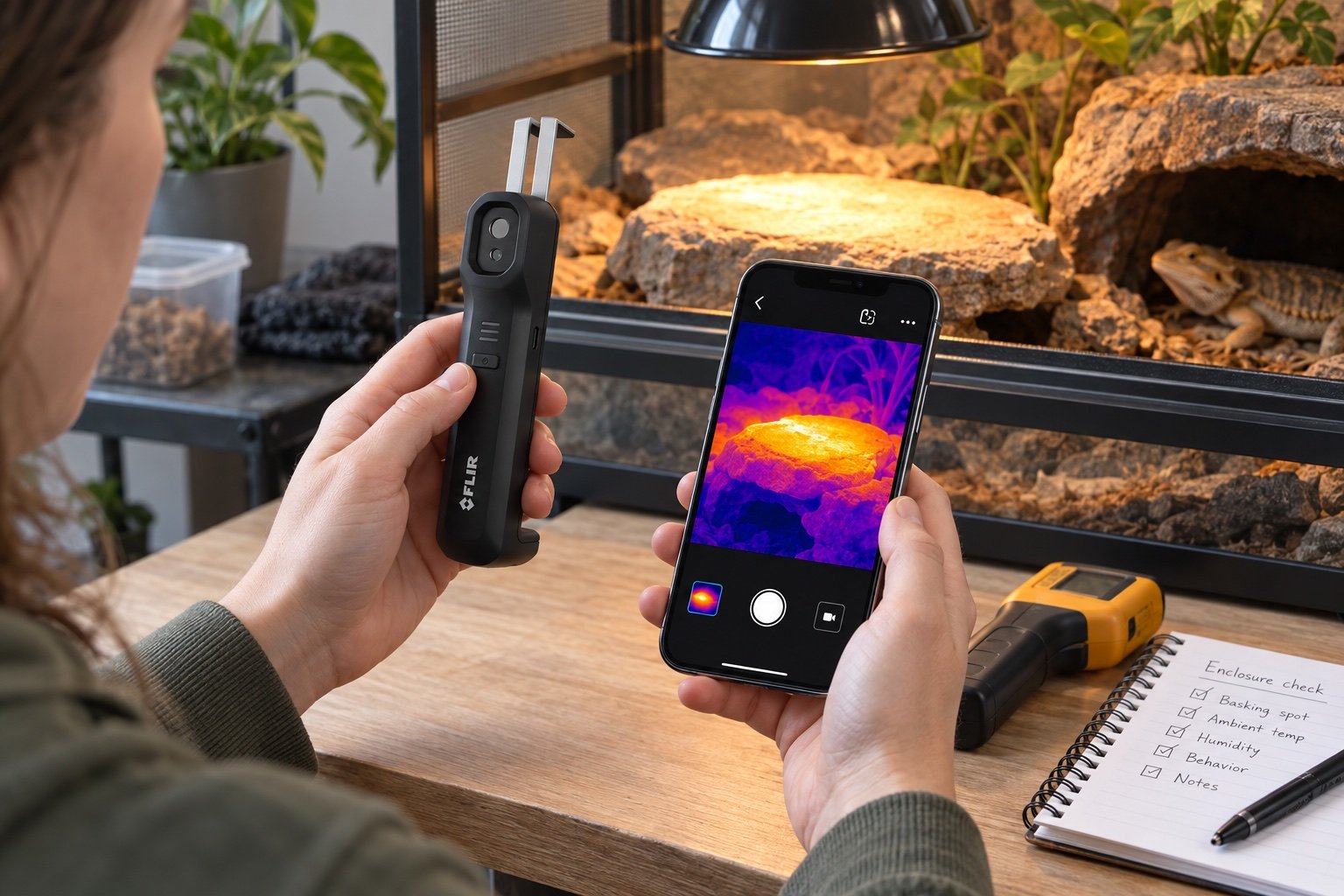
Quick verdict: The renamed FLIR Edge Pro is a capable thermal mapping tool for racks, basking zones and electrical checks. It reveals patterns that a single spot meter misses, but shiny surfaces, glass and emissivity can produce persuasive-looking errors.
The useful comparison is the complete enclosure, not the number on the display. Our basking temperature measurement and thermometer guide provide the surrounding checks.
| Point | What to know |
|---|---|
| Thermal sensor | 160 × 120 native resolution |
| Range | -20°C to 120°C and 0°C to 400°C modes |
| Connection | Wireless phone or tablet connection |
| Protection | IP54, 2 m drop test |
The name changed, the job did not
FLIR renamed the FLIR ONE Edge Pro to FLIR Edge Pro in late 2025. Older listings and tutorials may use the previous name. The wireless design remains the main advantage in an enclosure room: you can hold the camera near a hard-to-reach surface while viewing the image on the phone.
Thermal images need surface context
A heat map shows emitted infrared energy, not air temperature and not the reptile’s internal temperature. Glass can reflect the room or the keeper. Glossy tile and metal can read strangely because emissivity differs from bark or matte stone. Set the material class, avoid shooting through glass and confirm important points with a contact or infrared measurement method you understand.
Use it to find shape, then measure
Scan the entire habitat for hot edges, cold corners and uneven lamp coverage. Mark the suspicious area and take repeatable readings at the same distance. The hottest-pixel marker is helpful, but it can jump to a reflection or lamp guard. Our basking temperature guide gives a repeatable inspection route.
The accuracy figure needs perspective
FLIR specifies accuracy of plus or minus 3°C or 5 percent under defined conditions after warm-up. That is not laboratory precision at every surface. The camera earns its keep by showing distribution and unexpected differences. Use a thermostat probe and logger for continuous control, and use the camera to ask where the system deserves a closer look.
When the cost makes sense
A breeder with many enclosures, a custom rack builder or someone diagnosing electrical and insulation problems can use it regularly. For one habitat, a competent spot infrared thermometer plus careful mapping is cheaper. Compare the methods in our IR thermometer vs probe guide before assuming a color image is automatically more accurate.
What a good installation looks like after one week
The equipment should be boring. Cables remain where they were fixed, schedules occur at the expected local time and the animal can use the enclosure without touching a probe or blocking a sensor. Charts show ordinary cycles rather than unexplained steps. Alerts are rare enough that someone will act on them.
Repeat the acceptance check after major cleaning, seasonal room changes or firmware updates. If the system cannot recover cleanly from a routine interruption, it is not ready to become invisible infrastructure.
Think about the next person who will touch it
A clear label and one-page record are better than a clever setup that only its builder understands. Name every channel by enclosure and job. Put the normal reading range, emergency shutoff and last test date where a carer can find them without opening an account or searching old messages.
Keep spare batteries, compatible probes and a basic manual near the room, but outside humid air. Do not store an unknown spare heater and assume it can be connected to the same controller. Record wattage, control type and the settings that were actually tested.
Review cost as part of the system
The purchase price is only the beginning. Include replacement sensors, lamps, batteries, cloud plans and the time needed to export or inspect data. A cheaper product that creates weekly false alarms can cost more attention than a simpler, stable device.
That does not mean the most expensive option wins. Buy the least complex system that safely performs the required job and leaves a readable record. Extra channels and connected features are worthwhile when they remove a real task, not when they merely make the dashboard look complete.
Keep the system easy to reverse
During early testing, use mounts and routing that can be adjusted without damaging the habitat. Mark the successful positions before making them permanent. Change one part at a time and keep the previous setting in the record. If the result gets worse, you should be able to return to the proven baseline.
Reversibility also applies to software. Export settings or photograph every screen before a reset. Avoid experimental automation on the same day that lamps, probes or enclosure furniture change.
Use the animal’s routine as a final check
Numbers describe the environment, while behavior shows how the animal uses the available choices. Note basking, hiding and movement at the same times for several days. A new device may be working electrically while its light, sound, airflow or placement alters normal use of the habitat.
Behavior cannot diagnose a technical fault by itself. Treat an unexpected change as a reason to inspect the enclosure, verify measurements and consider health, not as permission to keep adjusting settings until the chart looks pleasing.
Common mistakes
- Trusting the first stable-looking number without mapping the surrounding zone
- Changing several settings at once and losing the cause of the result
- Leaving probes, cables or mounts where normal animal movement can shift them
- Treating an app or remote alert as the primary safety control
- Skipping a power-recovery test because the device retained settings once
Related Reptile Tech Lab guides
Frequently asked questions
Can it measure through terrarium glass?
It mainly sees the glass surface and reflections, not a reliable temperature behind it.
Is 160 × 120 enough?
It is useful for enclosure-scale patterns when the camera is used at a sensible distance.
Does it replace a thermostat probe?
No. It is an inspection tool, not continuous control.
Why do shiny surfaces look wrong?
Low emissivity and reflections can distort apparent temperature.