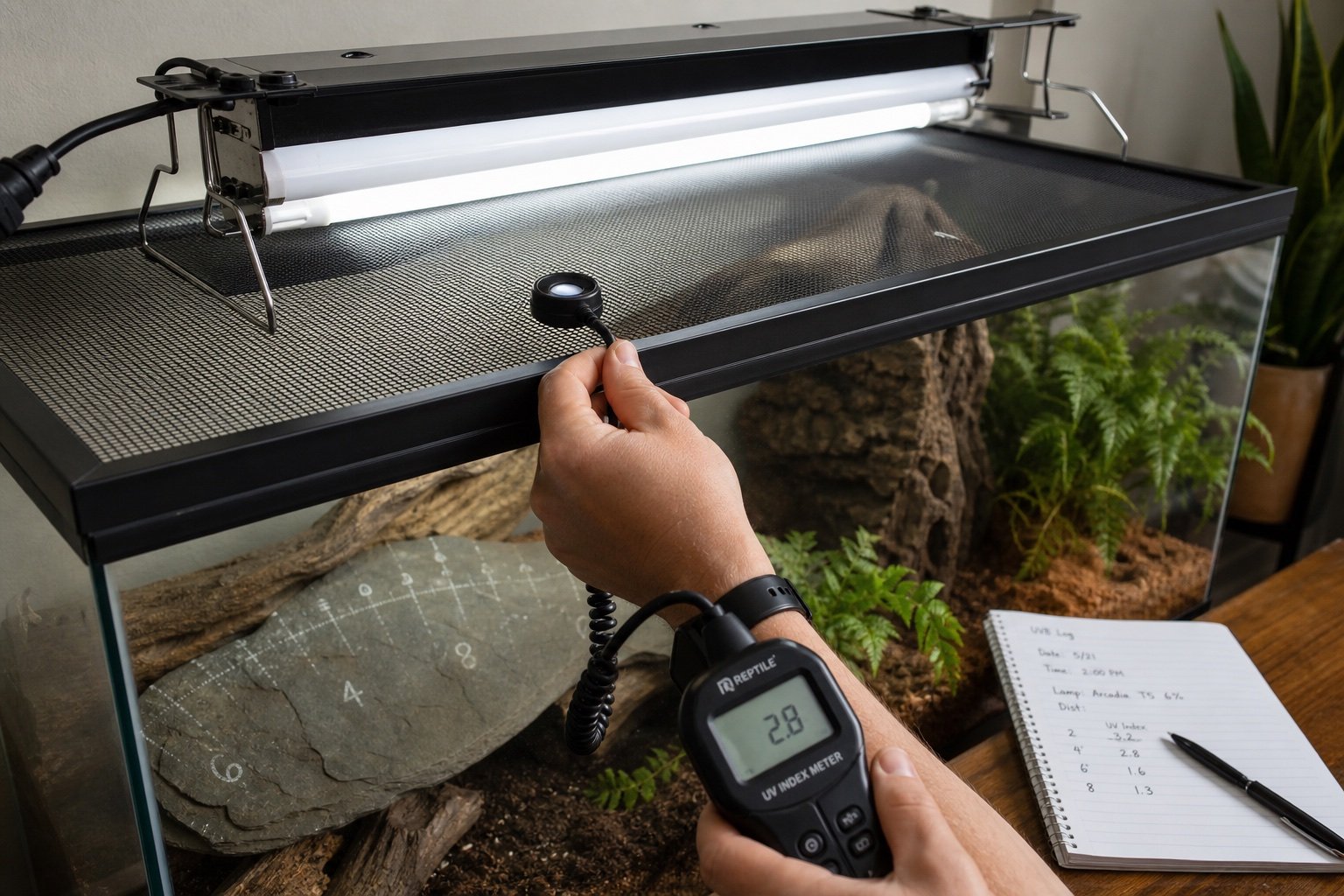
Quick verdict: UVB through mesh cannot be corrected with a universal percentage. Screens differ too much. Measure the same lamp at the same point above and below the lid, then map the basking area below the final installation.
Fine dark mesh, thick wire and oblique lamp angles usually block more radiation than an open, thin screen. Distance compounds the loss because the beam has already spread before it reaches the animal.
| Setup or factor | Published or practical value | Use |
|---|---|---|
| Lamp and reflector | Keep unchanged | Prevents a false comparison |
| Meter angle | Point at lamp center | Controls cosine error |
| Distance | Mark exact positions | Separates screen loss from distance loss |
| Warm-up | Use the same interval | Keeps lamp output comparable |
A repeatable test
Warm the lamp for the manufacturer-recommended period. Take three readings at a marked point without the screen, replace the screen without moving the lamp or meter, then take three more. Divide the lower average by the open average to find transmission.
Map the animal zone
The loss percentage is only the first step. Put the enclosure back together and measure the basking surface, nearby branches and the shaded edge. This final map is what guides husbandry.
Why online percentages disagree
Mesh products use different wire thickness, pitch, paint and open area. Lamp angle also changes how much wire the radiation encounters. A result from another lid is a rough warning, not a calibration value.
Safe corrections
First improve lamp alignment or reduce unnecessary separation. If output remains low, choose a more suitable fixture. Do not remove a secure lid or create a burn route simply to chase a number.
Keep a record
Photograph the meter position and write down tube age, distance and screen model. Retest after replacing the top, moving decor or changing to a different UVB lamp.
A commissioning routine that catches mistakes
Assemble and run the system before the animal depends on it. Photograph the final positions, label cables, and compare the working zone with an independent instrument. Test one normal day, one night transition and a short power interruption. The goal is not a perfectly flat chart. It is a stable, understandable gradient with safe recovery.
Recheck after cleaning because fixtures, probes and branches rarely return to the exact same position by accident. A two-minute baseline check is cheaper than troubleshooting weeks of unexplained behavior.
Common mistakes
- Comparing readings taken at different distances
- Holding the meter by hand at changing angles
- Testing a cold lamp against a warm lamp
- Using one center reading for the whole enclosure
- Assuming mesh affects visible light and UVB equally
How to verify the result in a real enclosure
Lighting work becomes much easier when the enclosure is treated as a map rather than a box with one reading. Mark the basking center, both edges of the perch, the warm hide entrance and the darkest retreat. Take measurements at the height of the animal’s back. This reveals whether the reptile can make small choices instead of moving between two extremes.
Visible light, UVB and heat overlap during the day, but each should be evaluated separately. A bright enclosure can still have weak UVB, and a strong UVB fixture does not create the correct basking surface temperature. Keep the lighting schedule consistent, control heat with suitable hardware, and change only one part before repeating the map.
A practical seven-day check
- Day one: photograph positions, record room conditions and capture baseline readings.
- Day two: review the full day-night transition and check that schedules occurred at the intended local time.
- Day three: inspect mounts, probe restraints, plugs, tubing and any area exposed to moisture.
- Day four: compare the main reading with an independent instrument placed beside it long enough to stabilize.
- Day five: review animal access and behavior. Confirm that equipment does not block hides, climbing routes or the cool zone.
- Day six: simulate one safe failure, such as a short internet loss or power interruption, then check recovery.
- Day seven: save the final settings and observations in the enclosure record.
Repeat the short version of this audit after major cleaning, seasonal room changes or equipment replacement. The point is not constant tinkering. It is catching the few changes that can quietly alter a previously stable habitat.
Related Reptile Tech Lab guides
Frequently asked questions
Does black mesh block more UVB?
Color alone is not enough to predict it. Open area, thickness and coating all matter.
Can I estimate loss from a photo?
No reliable husbandry decision should rest on a photo estimate.
Which meter is appropriate?
A meter designed to read UV Index, such as the model discussed in our Solarmeter 6.5R review.
Should the lamp touch the mesh?
Follow fixture clearances and keep heat, electrical and animal-contact safety ahead of output.