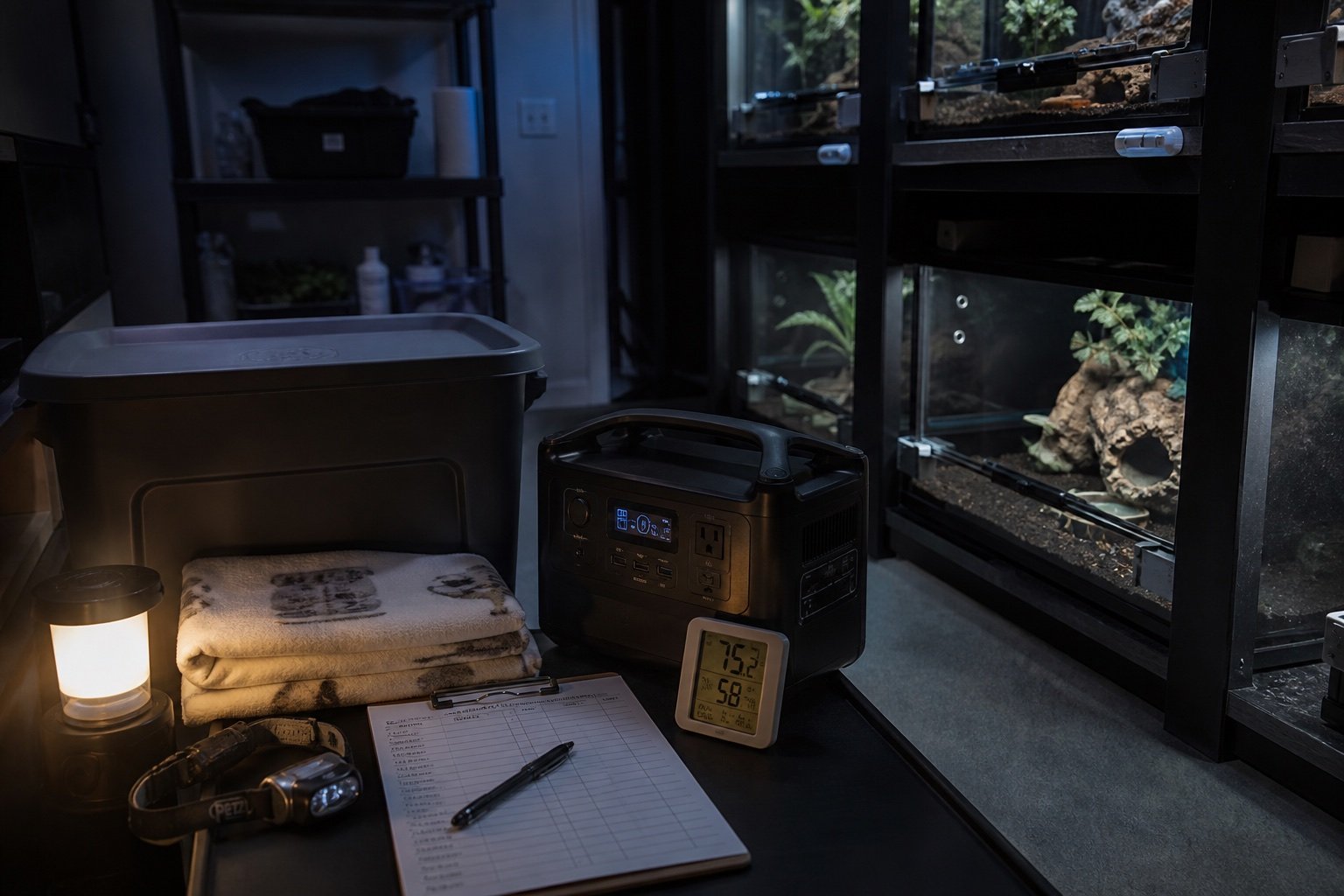
Quick verdict: A useful outage plan protects animals from the rate of temperature change, not from a single scary room reading. Prioritize vulnerable species and incubators, conserve enclosure heat safely, keep ventilation adequate and record what happened during recovery.
Reptile power outage plan: protect heat, airflow and records is a narrow buying and setup question, so this guide stays focused on that job. It does not repeat our broader category pages. The aim is to help you choose, install and verify the equipment without turning one convenient device into a single point of failure.
What matters in this comparison
| Factor | Option or result | Why it matters |
|---|---|---|
| First priority | Incubators and medically fragile animals | Small thermal margin |
| Second priority | Tropical or very young animals | Monitor cooling rate |
| Later priority | Stable adults in mild rooms | Avoid unnecessary handling |
| Never use indoors | Fuel-burning outdoor heaters | Carbon monoxide risk |
Specifications are useful for screening products, but enclosure performance depends on placement. Room temperature, ventilation, mesh, substrate moisture and animal access can move the result far from a brochure figure. Work from a measured baseline and change one variable at a time.
How to set it up
1. Write normal ranges
Include each enclosure and incubator. Test the result under normal enclosure conditions and write down what you observed. A setting that works on an empty bench can behave differently after decor, ventilation and daily room changes are added.
2. Stage independent thermometers
Battery devices still work when mains power fails. Test the result under normal enclosure conditions and write down what you observed. A setting that works on an empty bench can behave differently after decor, ventilation and daily room changes are added.
3. Choose safe backup heat
Follow product indoor-use rules. Test the result under normal enclosure conditions and write down what you observed. A setting that works on an empty bench can behave differently after decor, ventilation and daily room changes are added.
4. Store contact details
Vet, utility and alternate location. Test the result under normal enclosure conditions and write down what you observed. A setting that works on an empty bench can behave differently after decor, ventilation and daily room changes are added.
5. Run a tabletop drill
Practice decisions before winter. Test the result under normal enclosure conditions and write down what you observed. A setting that works on an empty bench can behave differently after decor, ventilation and daily room changes are added.
What ownership looks like after the first week
The first week should be treated as commissioning, not proof that the system will remain stable. Check the morning minimum, daytime peak and the transition between them. Look for loose probes, wet connectors, drifting clocks, blocked vents and any behavior that suggests the animal cannot use the intended zone.
After the setup settles, use a short written routine. A glance at the device is not enough. Compare it with an independent instrument, inspect cables and mounts, and review stored history when available. Replace consumable parts based on condition and verified performance rather than memory.
Common mistakes
- Opening enclosures repeatedly
- Using candles or combustion heaters near animals
- Feeding during a prolonged cold event
- Heating one spot without monitoring the rest
- Restoring every heater at once without checking controls
Who this approach suits
This approach suits keepers who want a system that another person can understand during a holiday or emergency. It also scales better across several enclosures because labels, baseline readings and failure tests remove guesswork. If a device requires constant manual correction, the installation needs work even when its feature list looks impressive.
How to verify the result in a real enclosure
Write the failure order before buying backup equipment. Decide what happens if power disappears, Wi-Fi drops, a relay sticks on or a caregiver presses the wrong control. Critical devices should fail into a state that gives you time to respond, and their normal state should be visible without opening several apps.
Run the plan with real labels and real cables. Disconnect one item at a time, confirm the expected alert, and record how quickly conditions move. That rate of change is more useful than a generic emergency number because it reflects the enclosure, room and season you actually have.
A practical seven-day check
- Day one: photograph positions, record room conditions and capture baseline readings.
- Day two: review the full day-night transition and check that schedules occurred at the intended local time.
- Day three: inspect mounts, probe restraints, plugs, tubing and any area exposed to moisture.
- Day four: compare the main reading with an independent instrument placed beside it long enough to stabilize.
- Day five: review animal access and behavior. Confirm that equipment does not block hides, climbing routes or the cool zone.
- Day six: simulate one safe failure, such as a short internet loss or power interruption, then check recovery.
- Day seven: save the final settings and observations in the enclosure record.
Repeat the short version of this audit after major cleaning, seasonal room changes or equipment replacement. The point is not constant tinkering. It is catching the few changes that can quietly alter a previously stable habitat.
Related Reptile Tech Lab guides
Frequently asked questions
Should I rely on the built-in display?
No. Use a separate thermometer, hygrometer, light meter or logger appropriate to the job. Independent verification catches probe movement and controller errors.
How long should I test before animals or eggs depend on it?
At least one complete day-night cycle, and longer for equipment affected by room weather or water use. Incubation and emergency systems deserve several days plus a power-loss test.
Can an app replace local control?
An app is useful for history and alerts. Critical regulation should continue safely when the phone, router or cloud service is unavailable.
What should I record?
Record device model, installation date, set points, probe location, baseline readings and the result of outage or disconnection tests. Those notes make later troubleshooting much faster.