Editorial note: this guide compares controller designs, published specifications and setup risks. A thermostat is a safety device, so verify the manual, electrical rating and heater compatibility for the exact model sold in your country.
Verdict: The best reptile thermostat is the one that matches the heat source and fails in a predictable way. Herpstat 1 SpyderWeb is the most complete single-zone option here for keepers who value proportional control, alarms and remote records. Exo Terra’s 600W Dimming and Pulse model is a practical all-round controller for a display enclosure. HabiStat’s dimming models remain a sensible match for light-emitting basking lamps, while Inkbird ITC-308 and Zoo Med ReptiTemp make more sense when simple on/off control suits the equipment.
Do not choose from wattage or price alone. A controller can have enough electrical capacity and still use the wrong control method for the heater. Start with the heater, the animal’s required gradient and the consequence of a failed probe. Then pick the thermostat.
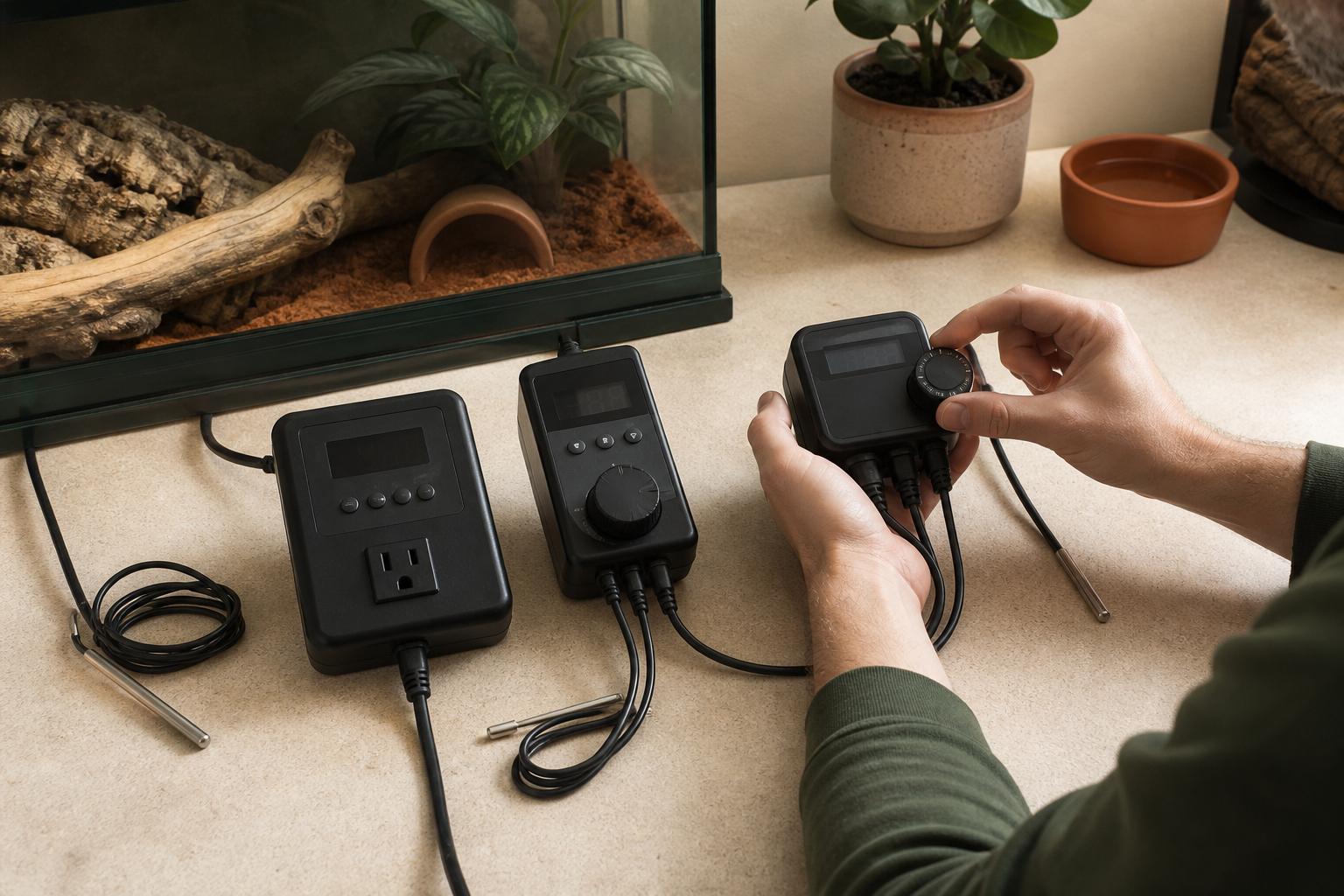
Quick recommendations
| Use case | Starting point | Why |
|---|---|---|
| Premium single enclosure | Herpstat 1 SpyderWeb | Proportional control, schedules, replaceable probe, audible and remote alerts, safety relay |
| Mixed heat sources | Exo Terra 600W Dimming and Pulse | Dimming and pulse modes, day/night settings, light-sensing probe |
| Visible basking lamp | HabiStat dimming thermostat | Smooth power adjustment designed around lamp control |
| Heat mat or non-lighting load | Inkbird ITC-308 or Zoo Med ReptiTemp | Simple on/off control and easy plug-in setup |
| Two independent enclosures | A true multi-output reptile controller | Separate probes and control channels prevent one enclosure from driving another |
Control type matters more than the brand name
An on/off thermostat supplies full power until the measured temperature reaches a threshold, then removes power until the temperature falls by a set differential. That is easy to understand and works with many mats, cables, ceramic heaters and cooling fans. The thermal mass of the enclosure determines how much overshoot occurs after power stops.
Pulse proportional control sends power in repeated pulses and changes the duty cycle as the temperature approaches the target. It can hold some non-lighting heaters more steadily than a wide on/off differential. Do not use obvious pulsing with a visible lamp unless the manufacturer explicitly supports the combination; flicker is distracting and can shorten lamp life.
Dimming control varies power smoothly. It is usually the best fit for halogen and incandescent basking lamps because the lamp brightens and dims instead of snapping on and off. Some controllers can also run deep heat projectors or ceramic emitters, but the manual is the authority. The temperature monitoring guide explains why the thermostat’s probe and an independent thermometer do different jobs.
Herpstat 1 SpyderWeb
Herpstat is the strongest choice when one heat zone deserves serious monitoring. Spyder Robotics lists proportional heating, soft startup, four scheduled temperature periods, sensor matching, auto power matching, high and low tracking, a history graph, Wi-Fi viewing, outage tracking, email alerts and a separate internal safety relay. The current single-output model is rated for 700 total watts.
The removable steel-tipped probe and user-replaceable fuse are practical ownership advantages. If a probe is damaged, the entire controller does not automatically become waste. The unit also stores settings through an outage and can shut heat off when the sensor fails or a safety condition is met.
Complexity is the cost. Remote features depend on network setup and should never be the only alarm path. The thermostat still needs to control safely without Wi-Fi. Read the full Herpstat 1 review for schedule setup, probe calibration and the limits of remote monitoring.
Exo Terra 600W Dimming and Pulse
Exo Terra’s 600W controller offers both dimming and pulse proportional modes, separate day and night temperatures and a 10 to 60°C range. The remote probe includes a light sensor, and the company lists compatibility with heat mats, cables, ceramic heaters and heat bulbs. That makes it flexible for a typical display enclosure where the heat source may change later.
Mode selection still matters. Use dimming for a light-emitting basking lamp unless the manual directs otherwise. Pulse control is better suited to a non-visible heater that tolerates cycling. The controller includes memory and protection features, but you should still test power recovery with the enclosure empty and verify time, mode and setpoints after reconnecting power.
HabiStat dimming thermostats
HabiStat’s Classic Pro Dimming thermostat supports up to 450 watts, a detachable probe, an LCD and over- and under-temperature alarms. Other HabiStat digital day/night models are sold with higher limits and timer functions, so check the exact product name rather than assuming every black controller has the same specification.
The dimming behavior is the main reason to buy one. A basking lamp can settle near the required output without repeated hard starts. HabiStat also describes a fast-blow fuse and safety cutout on current designs. Those protections are useful, but an independent temperature display remains necessary.
Inkbird ITC-308
The ITC-308 is a general-purpose dual-stage on/off controller rather than a reptile-specific proportional thermostat. It has separate heating and cooling outlets, adjustable differentials, high and low alarms, calibration and compressor delay. Inkbird lists a 10A total load and model-dependent wattage, so use the rating on the exact regional unit.
It can be a good value for a heat mat, cabinet heater or fan. It is a poor substitute for a dimming thermostat on a visible basking lamp. The controller body and sockets are not waterproof even though Inkbird describes the probe as IP68. Mount all mains connections outside spray and condensation paths.
The detailed Herpstat vs Inkbird comparison covers why a cheaper on/off controller and a proportional reptile controller are not direct equivalents.
Zoo Med ReptiTemp Digital Thermostat
Zoo Med’s RT-600 is a straightforward on/off controller with heat and cool modes, a remote probe and a 50 to 122°F control range. Zoo Med lists up to 600 watts for heating and 150 watts for cooling. It suits a keeper who wants simple controls and does not need graphs, schedules or remote alerts.
The limitation is the same as other basic controllers: the enclosure’s response determines the temperature swing. A high-mass hide or thick substrate can continue warming after the heater switches off. Measure the actual basking surface and ambient gradient during setup.
Probe placement decides what the controller sees
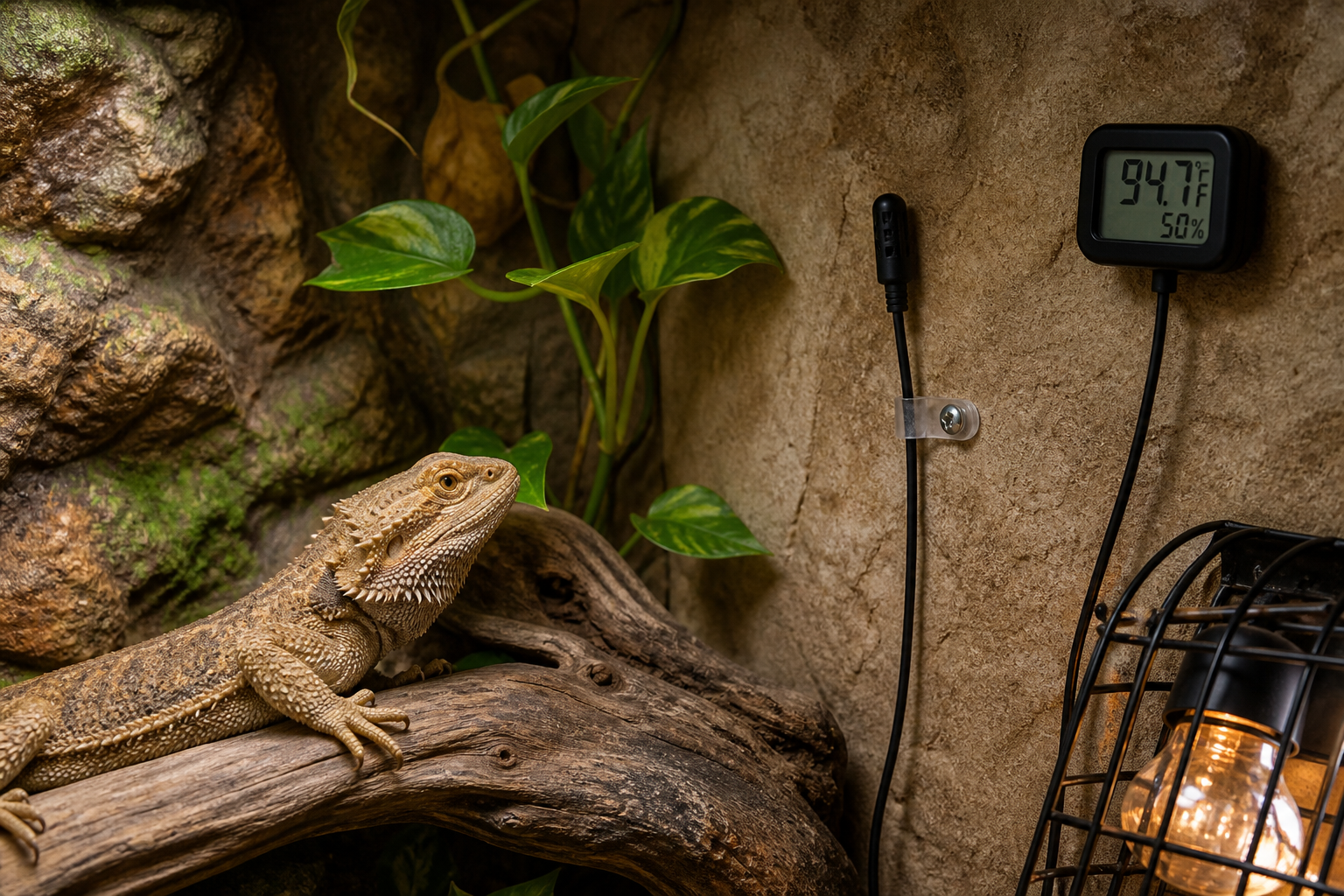
A thermostat controls the temperature at its probe, not the animal’s body and not every point in the enclosure. Secure the probe so the animal cannot move it closer to or farther from the heater. Do not leave a loose cable that can loop around a reptile or be pulled under furniture.
For a heat mat, place the probe where the controlled warm surface could become hottest under normal use. For overhead heat, follow the controller and heater manuals, then verify the accessible basking area with an appropriate independent instrument. Avoid placing a probe directly against a lamp unless the manufacturer calls for it.
Use a separate thermometer beside the controlled point and at the cool end. An infrared thermometer reads surfaces, while a digital probe or logger reads local air or contact temperature. Neither replaces the other.
Safety features worth paying for
- A sensor-failure response that cuts heat rather than applying full power
- Independent high-temperature shutdown or safety relay
- Audible alarms that work without internet access
- Settings retained after power loss
- A replaceable probe and accessible fuse
- A clear maximum load for the exact supply voltage
- A grounded plug and properly rated outlet where required
Remote notifications are useful but fragile. A router, cloud service, phone setting or email provider can fail while the thermostat keeps operating. Treat remote alerts as an extra path, not the primary safety control.
How to size the electrical load
Add the wattage of every device connected to one controlled output and stay below both the watt and current limits. Do not use a splitter merely because the total appears low. One probe cannot safely control two enclosures that heat at different rates.
Inspect plugs, lamp holders and extension leads. Keep sockets off the floor and outside the enclosure. Use a drip loop anywhere water may run along a cable. Misting systems deserve their own circuit and routing plan; the reptile misting systems guide covers leak and electrical separation.
Setup test before an animal moves in
- Install the heater, probe and independent sensors in the finished enclosure.
- Confirm control mode, target, differential and alarm thresholds.
- Run the enclosure through a full day and night cycle while empty.
- Record warm surface, warm-side air and cool-side air at regular intervals.
- Move the probe slightly to learn how sensitive the setup is to displacement.
- Disconnect the probe if the manual permits a failure test and confirm safe shutdown.
- Interrupt power, restore it and verify the controller returns to the correct schedule.
A logger helps reveal a short overshoot that a spot check misses. Our coming guide to the best reptile thermometers and hygrometers explains placement and calibration without treating consumer accuracy claims as laboratory results.
What we would buy
For a valuable animal or a setup where overheating would happen quickly, the Herpstat’s safety hardware and history justify the price. For a display enclosure using a basking lamp, choose a reliable dimming controller that is sold and supported in your region. For a heat mat in a stable room, a simpler on/off model can be adequate when it is paired with independent monitoring and conservative settings.
Do not save money by pairing a sophisticated heater with the wrong controller. A basic thermostat that matches the load is safer than an impressive control panel running in the wrong mode.
Frequently asked questions
Can one thermostat control two reptile enclosures?
Only when it has independent outputs and a separate probe for each controlled zone. A power strip on one output does not create independent control.
Do I still need a thermometer?
Yes. The thermostat uses its own probe to control power. Independent instruments verify the basking surface, air gradient and cool side.
Is dimming always better?
No. Dimming is usually the right choice for visible heat lamps. Pulse or on/off control may suit mats, cables, ceramic heaters and cooling equipment better. Follow both manuals.
Should the thermostat probe go inside the enclosure?
The sensing tip usually must measure the controlled location, but the body and sockets stay outside. Secure the cable and follow the manufacturer’s placement instructions.