Editorial note: this guide compares current system designs and published specifications. Water near electricity demands careful installation. Follow every pump, timer and enclosure instruction.
Verdict: MistKing Starter v5 is the best expandable system for keepers who want fine mist, replaceable parts and room to add enclosures. Exo Terra Monsoon is easier to buy as a self-contained package for a small display setup. Budget pump kits can work, but nozzle consistency, timer control and replacement fittings matter more than the number of spray heads printed on the box.
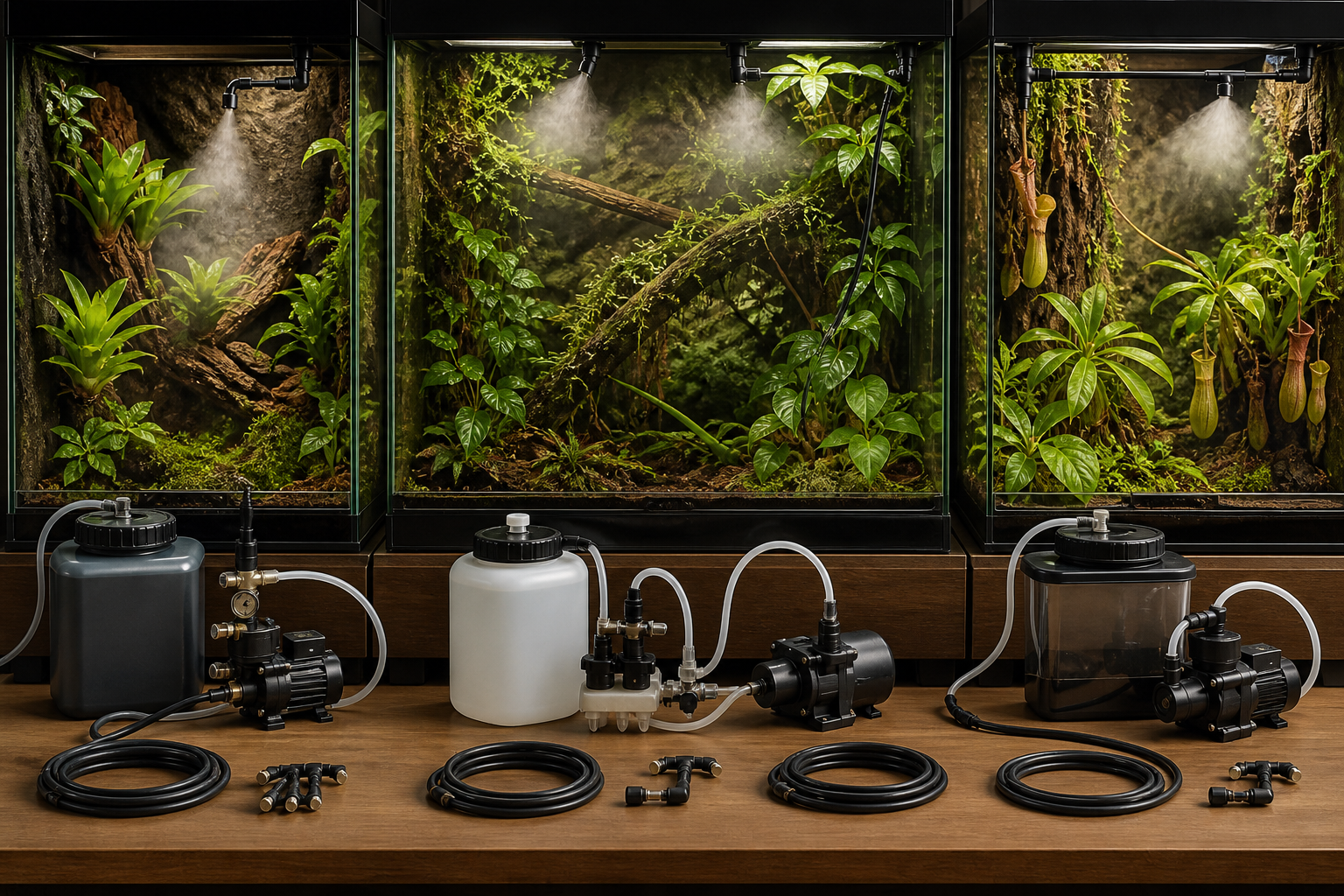
Shortlist by use case
| Use case | Starting point | Reason |
|---|---|---|
| Expandable multi-enclosure system | MistKing Starter v5 | Pressure pump, fine check-valved nozzle, standard tubing and support for up to ten nozzles |
| One small display vivarium | Exo Terra Monsoon Solo or Multi | Reservoir, pump and controller packaged together |
| Very small budget build | Serviceable generic pressure kit | Accept only if fittings, nozzles and timer can be replaced |
| Humidity-triggered control | Quality pump plus separate compatible hygrostat | Useful only after sensor placement and drying behavior are understood |
Misting is not fogging
A pressure misting system pushes water through fine nozzles and wets leaves and surfaces with droplets. An ultrasonic fogger creates suspended fog and can raise local humidity without providing the same drinking droplets. The two tools solve different problems.
Many reptiles benefit from a wetting and drying cycle rather than a flat humidity number. Choose duration and nozzle direction by observing surface wetting, drainage and recovery. Do not use continuous fog to hide poor ventilation.
Pump pressure and nozzle quality
A strong diaphragm pump maintains a fine spray across several nozzles. Weak pumps often produce coarse droplets at the far end of a line. Check the supported nozzle count at the tubing length and layout you expect, not only at the pump outlet.
Check valves reduce dripping after a cycle. A little residual water may still escape as line pressure falls. Position nozzles so a drip cannot pool on a heat source, electrical fitting or animal’s permanent resting spot.
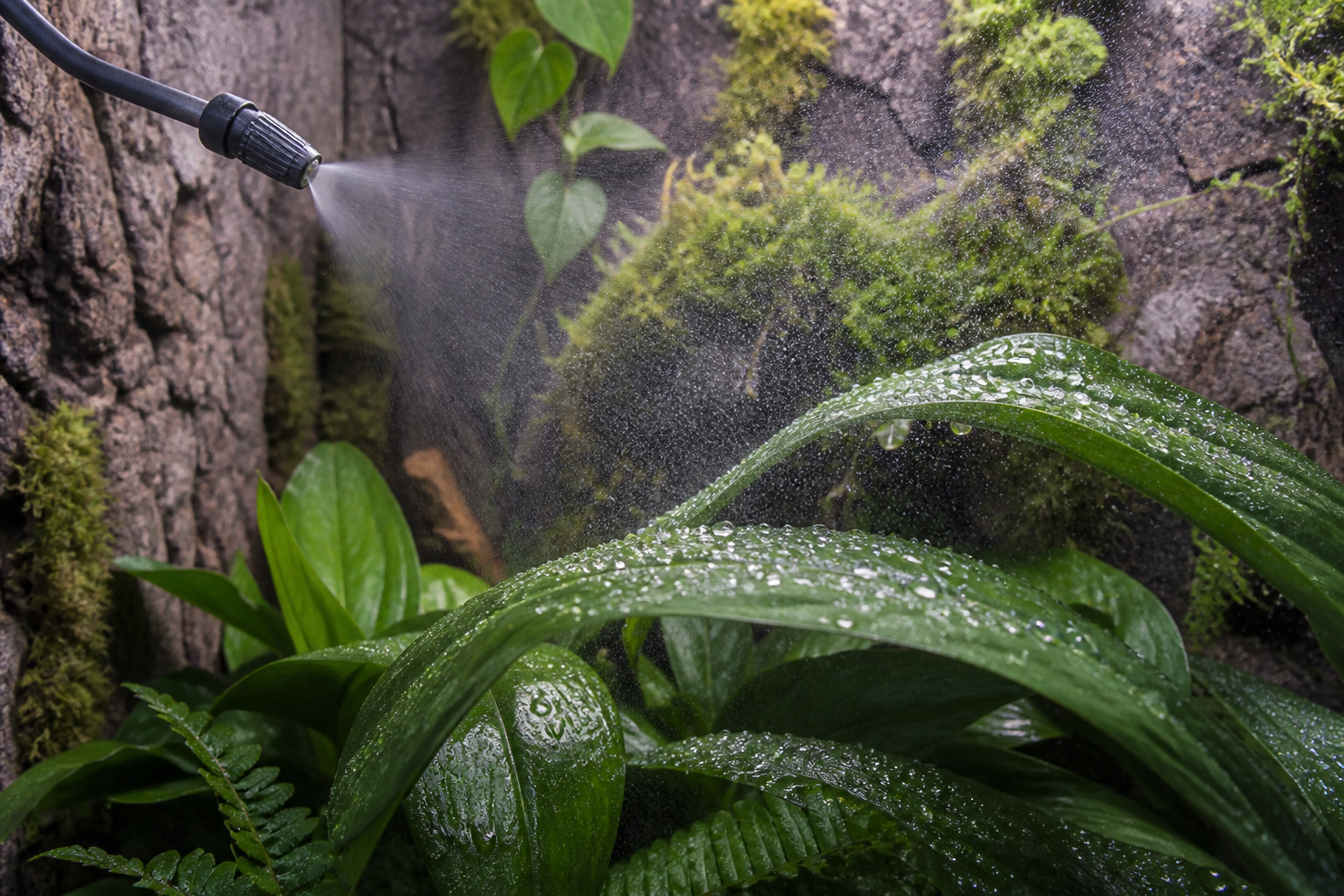
MistKing Starter v5
The current starter package includes a 24V pump rated by MistKing for up to ten nozzles, one Value L nozzle, 15 feet of quarter-inch opaque tubing, reservoir bulkhead, filter, ST-24 seconds timer and clips. The nozzle is described as producing roughly 50-micron droplets. A reservoir itself is not included.
That last detail matters. You must drill and seal a suitable container. The advantage is choosing capacity for the room instead of accepting a small built-in tank. Read the complete MistKing Starter review before deciding whether its extra installation work suits you.
Self-contained systems
Exo Terra Monsoon models combine reservoir, pump and controller in one unit. Setup is tidier for one or two enclosures, and there is no bucket bulkhead to install. The tradeoff is a smaller reservoir, proprietary packaging and less flexible expansion.
Measure usable reservoir volume against the real schedule. Run the system into a container for one complete day, measure the water and calculate refill frequency. Never estimate consumption from nozzle count alone.
Timer versus humidity control
A seconds timer runs a known duration at known times. It is predictable and easy to audit. A hygrostat responds to a sensor, but the reading depends on location and temperature. A sensor in the mist cone can stop the system before the enclosure is evenly wetted; one in a dry vent can overrun it.
Begin with timer control and observe several cycles. Add humidity logic only when it solves a measured problem. Pair the system with a logger from the thermometer and hygrometer comparison.
Reservoir design
Use a food-safe opaque container with a secure lid. Keep the intake above settled debris and large enough that the pump never runs empty between checks. Mark minimum and maximum levels.
Place the reservoir below nozzle height when the manufacturer recommends it and add the specified bulkhead. Test the fitting outside the reptile room. A slow leak can travel along tubing and reach an outlet before it becomes visible.
Water quality and maintenance
Minerals clog fine nozzles and leave deposits on glass and plants. Use the water quality recommended by the manufacturer. Keep a reservoir filter, inspect it monthly and clean or replace nozzles by the documented method.
Do not add disinfectant, supplement or medication to a misting reservoir unless every component manufacturer and veterinarian approves the practice. Fine aerosols change exposure routes, and residue can damage pumps or nozzles.
Routing lines safely
Cut tubing square, seat it fully and support long runs. Route lines away from lamp surfaces and hinges. Leave enough slack for maintenance without creating loops an animal can reach.
Put the pump on vibration-damping feet or a dense pad that does not block ventilation. Keep timers, adapters and power strips off the floor. Use drip loops and ground-fault protection where local electrical rules require it.
Nozzle placement
Aim across foliage or textured backgrounds rather than directly at the animal. Watch the spray with the enclosure empty. Make sure water does not collect inside lamp guards, camera housings or ventilation channels.
One nozzle can cover a small enclosure better than two badly aimed heads. Add nozzles only after checking dry areas. Multiple enclosures need balancing so the first nozzle does not receive a much stronger pattern than the last.
Failure tests
- Run every fitting over absorbent paper and inspect for slow leaks.
- Disconnect power mid-cycle and verify what the timer does after restart.
- Let the reservoir approach its safe minimum and confirm the intake stays submerged.
- Block one nozzle briefly using the maintenance method and inspect pressure elsewhere.
- Run the maximum daily schedule and measure drainage.
- Check humidity recovery rather than only the peak.
Record maintenance in the same system used for animal care. The guide to large reptile collection management explains how equipment tasks can live beside daily queues without cluttering animal histories.
What to buy with the system
- A properly sized opaque reservoir and lid
- Spare tubing, clips and at least one nozzle tip
- A shutoff valve or approved pressure-relief accessory where useful
- Independent temperature and humidity logging
- Leak sensors near the reservoir and pump for larger rooms
- A cleaning kit and dated maintenance log
Match the system to enclosure construction
Glass, PVC, screen and converted furniture handle water differently. A glass terrarium may retain moisture but collect runoff along the front track. A screen enclosure dries quickly and can spray the wall behind it. PVC is easy to drill, yet every penetration still needs a clean route that cannot abrade tubing. Decide where water will land and where it will leave before choosing pump size.
Drainage is part of the misting system. False bottoms, drain fittings and removable catch trays need enough capacity for a failed timer or stuck relay, not just a normal cycle. Put electrical strips above the lowest possible leak path and form drip loops in every power cable.
Calculate daily water use
Measure consumption instead of guessing. Fill the reservoir to a marked level, run the actual schedule for 24 hours and record the difference. Repeat during the warmest and coolest parts of the year because ventilation and drying time change. Daily use determines reservoir size, refill frequency and whether a weekend absence is realistic.
A large reservoir reduces chores but also increases the amount available to leak. Choose capacity from measured demand plus a sensible reserve. For a collection, record refills in the same workflow used for feeding and equipment checks. Our guide to managing a large reptile collection explains how to make those checks visible to everyone in the room.
Seasonal tuning without chasing humidity
Room heating, air conditioning and outdoor weather can change enclosure drying time. Adjust one variable at a time: cycle length, cycle count or ventilation. Then observe several complete wet and dry periods. Constantly changing all three makes it impossible to know what worked.
Use a separate logger to see the curve between cycles, but pair the graph with direct observation of substrate, leaves and animal behavior. The target is a repeatable water cycle suited to the species, not a flat humidity line. The temperature monitoring guide covers sensor placement and verification methods that also apply to humidity logging.
Frequently asked questions
How many nozzles do I need?
Start with the fewest that wet the usable surfaces evenly. Pump capacity, tubing length, enclosure size and plant density all matter.
Should misting be controlled by humidity?
Not automatically. Timer control is often more predictable. Use a hygrostat only after proving sensor placement and understanding the enclosure’s drying cycle.
Can tap water be used?
Follow the system maker’s guidance and consider mineral content. Hard water can clog nozzles and leave deposits.
Does misting replace a water bowl?
No. Drinking strategy is species-specific, and many reptiles still need clean accessible water even when surfaces are misted.