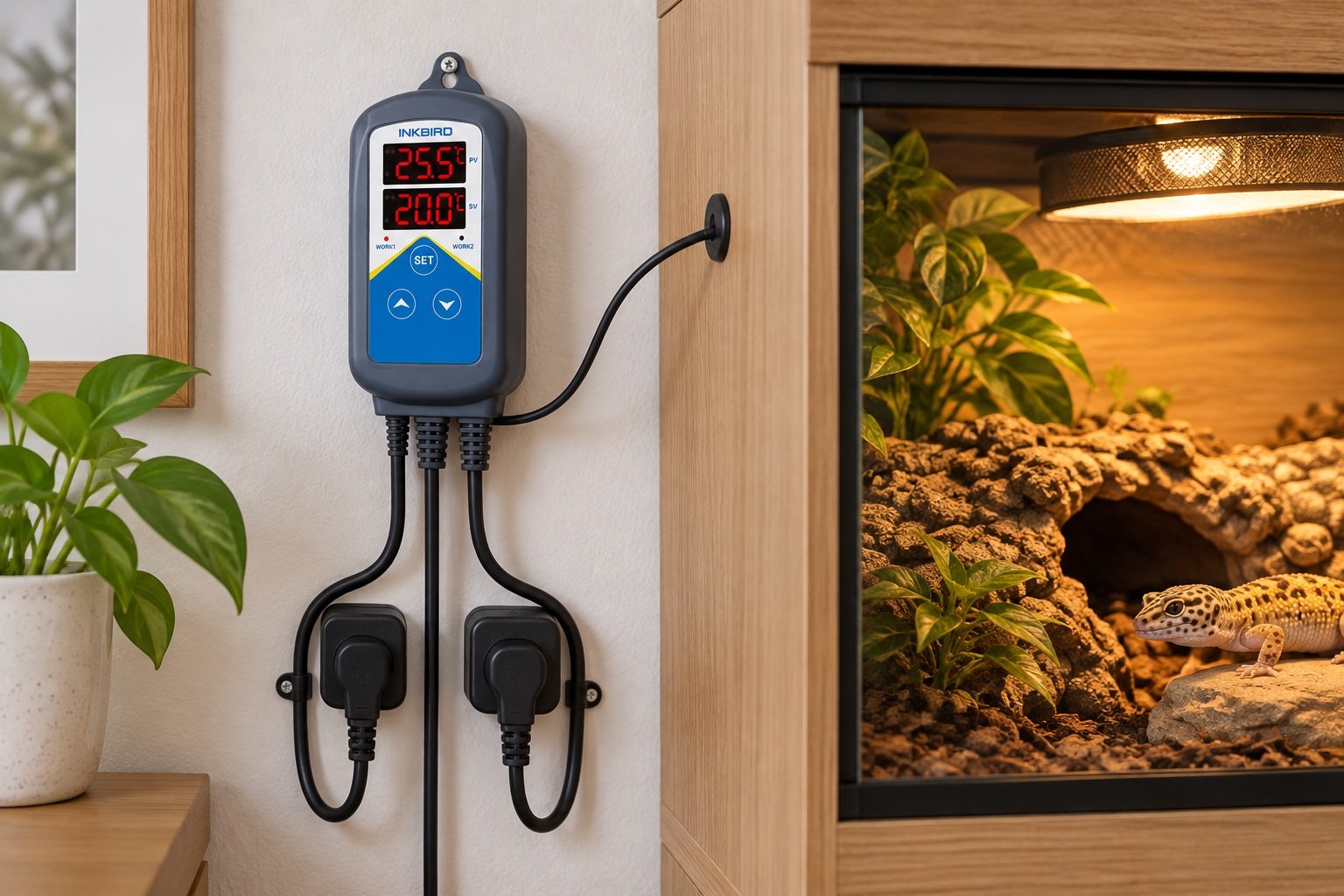
Quick verdict: The ITC-306T is a straightforward heating-only, on/off controller with two sockets on one relay. It can suit non-light heaters that tolerate cycling. It is a poor match for a halogen basking lamp and should not be mistaken for two independently controlled zones.
The useful comparison is the complete enclosure, not the number on the display. Our reptile thermostat guide and ceramic emitter vs deep heat projector provide the surrounding checks.
| Point | What to know |
|---|---|
| Control type | Heating only, on/off |
| Load | Up to 10 A, regional wattage varies |
| Schedule | Two timed temperature periods |
| Probe | 2 m NTC probe, IP67 probe body |
Two sockets do not mean two thermostats
Both outlets follow the same control decision. That can run two compatible heaters, but it cannot maintain separate temperatures or protect two unrelated enclosures. Combined load still matters. If the heaters serve different habitats, one displaced probe can affect both. The Herpstat vs Inkbird comparison explains the gap between a shared relay controller and a proportional reptile thermostat.
The day and night schedule is basic but useful
The controller stores two temperature periods across a 24-hour cycle. That is enough for a modest night drop without adding a separate timer. It is not a gradual sunrise routine. At the changeover, the target changes and the relay reacts. Measure the enclosure through several transitions because stored heat can make the first night reading look better than the rest of the night.
Choose a heater that can be switched
The ITC-306T turns power fully on and off. Ceramic emitters and some mats can tolerate that pattern when installed correctly. A bright lamp will visibly blink and its life may suffer. For light-emitting heat, a dimming controller is usually the cleaner choice. Read the heater instructions, stay below the controller and socket ratings, and keep a safety margin rather than treating 10 A as a daily target.
Water resistance stops at the probe
Inkbird rates the probe body IP67, not the display, plugs or cable junctions. Keep the controller and outlets outside the wet zone. Add drip loops and position the probe where mist cannot run along the cable into a socket. In a humid enclosure, inspect the cable entry and any protective sleeve during every deep clean.
A sensible acceptance test
Set a deliberately low target with no animal present and confirm both sockets switch together. Raise the target, watch the warm-up, and compare the controller with a separate logger placed beside the probe. Unplug power long enough to test memory, then check the schedule clock. Finally, loosen nothing: tug the probe restraint gently and make sure normal animal movement cannot change the reading.
What a good installation looks like after one week
The equipment should be boring. Cables remain where they were fixed, schedules occur at the expected local time and the animal can use the enclosure without touching a probe or blocking a sensor. Charts show ordinary cycles rather than unexplained steps. Alerts are rare enough that someone will act on them.
Repeat the acceptance check after major cleaning, seasonal room changes or firmware updates. If the system cannot recover cleanly from a routine interruption, it is not ready to become invisible infrastructure.
Keep a change log, even for a single enclosure
Record the date, old setting, new setting and reason. Add one observation after the next full day. This stops a sequence of sensible-looking tweaks from drifting far away from the original plan. It also helps another carer understand why an unusual schedule or position exists.
Firmware, app and clock changes belong in the same record as physical maintenance. After an update, confirm units, time zone, schedules, alarm limits and channel names. Do not assume a graph that looks familiar proves the outputs are mapped correctly.
Check the animal’s access around the hardware
Run a hand along the routes the animal can climb. Look for hot guards, sharp clips, adhesive edges and cable loops. Make sure a hide, plant or deep substrate cannot press against the sensor and create a false reading. Equipment placement is finished only when the animal can use the habitat normally without becoming part of the mounting system.
Observe the first week at ordinary care times, not only during a staged inspection. Feeding, misting, opening doors and moving bowls are the moments that disturb cables and airflow. If a control survives only when nobody touches the enclosure, it is not a durable installation.
Watch what happens during ordinary care
Open the enclosure, change water, mist, feed and move the usual hide or branch. Then check the hardware. Good installation survives those actions without a cable pulling tight, a probe moving or an alert becoming meaningless. A perfect result in an untouched display is less useful than a stable result during real care.
Ask another person to perform the round using the written labels. If they cannot identify the shutoff, correct sensor or affected habitat, improve the record. This is especially important when one controller or gateway serves several enclosures.
Plan the retirement path
Connected products eventually lose app support, batteries weaken and replacement probes disappear. Export data in an open format and keep essential settings in plain text. Avoid building a safety function that only one discontinued phone app can change.
Before replacing a working device, define the improvement you expect: quieter control, a second zone, remote alerts or better moisture protection. If the new product does not solve that specific limitation, maintenance and a spare part may be the better purchase.
Common mistakes
- Trusting the first stable-looking number without mapping the surrounding zone
- Changing several settings at once and losing the cause of the result
- Leaving probes, cables or mounts where normal animal movement can shift them
- Treating an app or remote alert as the primary safety control
- Skipping a power-recovery test because the device retained settings once
Related Reptile Tech Lab guides
- reptile thermostat guide
- ceramic emitter vs deep heat projector
- probe placement guide
- enclosure electrical safety
Frequently asked questions
Can it cool an enclosure?
No. The ITC-306T controls heating only.
Are the two sockets independent?
No. They share the same relay and temperature decision.
Can it run a basking bulb?
It can switch a lamp electrically, but visible on/off cycling makes it a poor choice for most basking bulbs.
Does it have a custom low-temperature alarm?
The model has limited alarm behavior, so use an independent monitor for husbandry alerts.