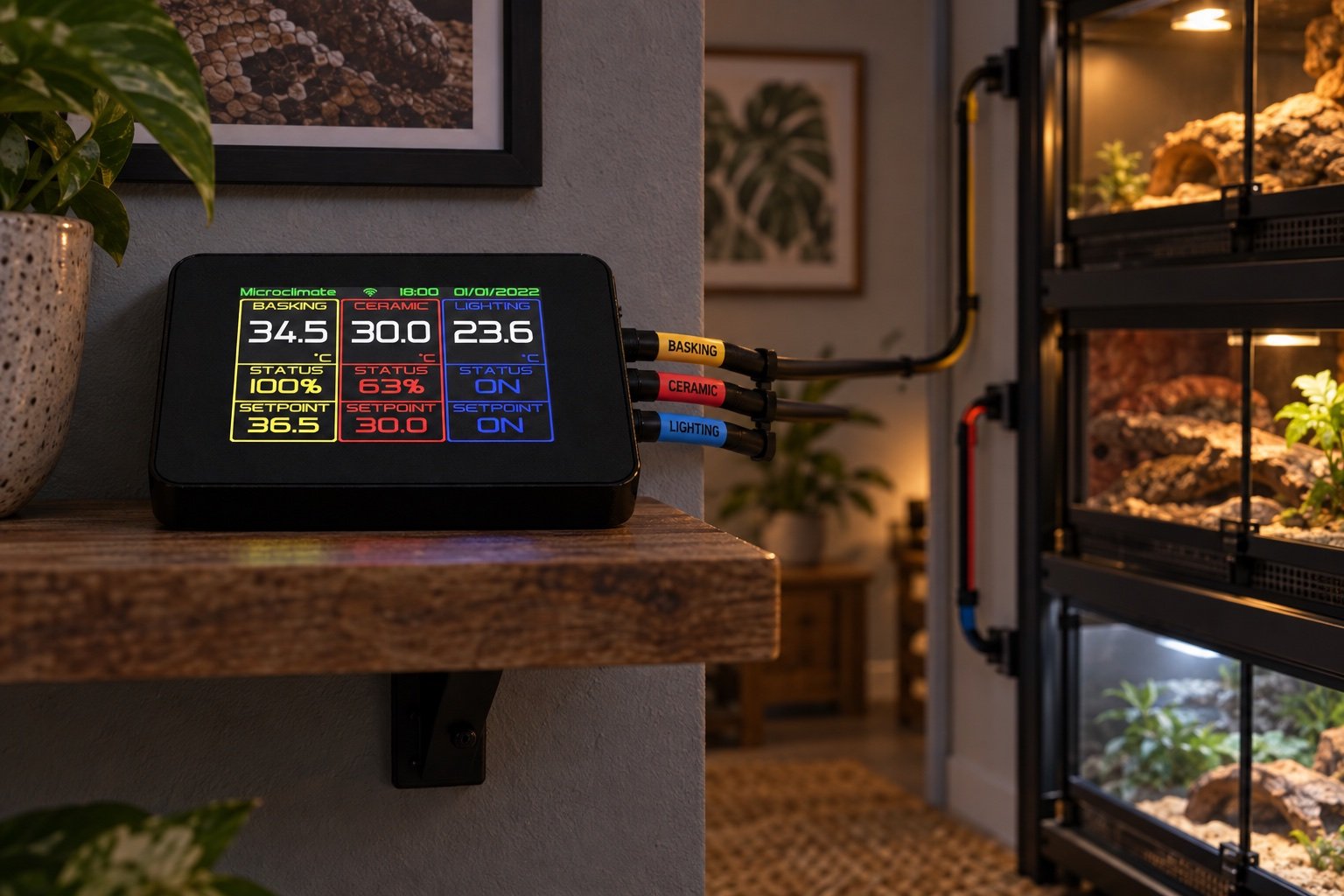
Quick verdict: The EVO Connected 3 makes sense for a complex habitat or a small bank of enclosures where three controlled outputs reduce cable clutter. Its advantage is coordination. That also makes careful labelling, load planning and failure testing non-negotiable.
We judge the device or method by the job it can repeat. Keep the Herpstat 2 SpyderWeb review and Zoo Med Environmental Control Center review nearby while planning the setup.
| Point | What to know |
|---|---|
| Channels | 3 controlled outputs |
| Interface | Local control plus connected features |
| Use case | Multi-device or multi-zone systems |
| Main risk | Complex setup can hide a mapping error |
Start with a channel map, not the app
Write down channel number, heater, probe, target, maximum safe temperature and fallback action. Attach the same channel number to both ends of every cable. Only then create the digital configuration. This catches the most dangerous setup error: a probe from one enclosure controlling a heater in another. A neat dashboard cannot reveal crossed physical wiring.
Three channels can solve different jobs
One habitat might use a dimmed daytime basking lamp, a separate background heater and a controlled cooling fan. A rack might use one channel per enclosure. Those layouts have different failure paths. If outputs influence the same air volume, run them together during testing. If they control separate animals, verify that settings and alarms never depend on a shared assumption.
Connected control should remain optional
Set the essential limits on the controller and confirm that heat remains stable when the network is unavailable. Remote changes are convenient, especially across seasonal room shifts, but they also make accidental edits easier. Use account security, document the approved configuration and avoid changing a set point from a phone without someone checking the physical enclosure afterward.
Check the boring physical details
Probe strain relief, cable routing and ventilation around the controller matter more than a polished graph. Keep mains connections dry and accessible. Do not bury the unit behind a rack where heat builds or where a warning display cannot be seen. The electrical safety guide shows how to separate low-voltage probes from wet equipment and mains leads.
Who should choose something simpler
A single enclosure with one heater rarely needs three outputs. Extra menus and wiring add more ways to make a mistake. In that case, compare the best reptile thermostats by heater type, not feature count. The EVO becomes attractive when its third channel replaces a real second or third control problem, not when it merely leaves room for imaginary upgrades.
A seven-day field check
Run the finished setup for a week before treating it as settled. On day one, photograph every position and record the room conditions. Watch the first warm-up and the final hour of the schedule. Midweek, compare the main reading with an independent instrument placed beside it long enough to stabilize. Near the end of the week, test a safe interruption such as a network loss or short power cut.
Do not tune settings every time a single reading looks odd. Look for a repeated pattern and change one variable. A clear notebook entry is more useful than a folder of screenshots with no explanation.
Separate a useful alert from ordinary noise
Set warnings far enough from normal cycling that they mean something, but early enough to allow a response. Review a full week of data before tightening limits. Misting peaks, nighttime drops and door-open care periods may be expected. Label those events in the record so they are not mistaken for hardware faults.
Every alarm needs a person, a time window and an action. If nobody can reach the enclosure, a remote notification mainly documents the problem. Keep contact details and the safe immediate steps with the care instructions, then test the alert on another network.
Use independent evidence for the important claim
If a thermostat says the basking zone is safe, confirm the surface with the correct instrument. If a logger claims the room stayed stable, compare it with a second sensor during commissioning. If an app says a schedule ran, observe the actual lamp, fan or pump. Independent checks should use a different device and, where possible, a different power path.
Agreement once is not proof forever. Recheck after moving decor, replacing a bulb, changing substrate depth or altering room heating. Those changes can affect the habitat more than a small adjustment inside the app.
Check the setup at two room temperatures
A controller that behaves well on a mild afternoon may struggle during the coldest night or hottest sunny day. Repeat the map when the room changes naturally. Do not create dangerous conditions for a test, but use seasonal weather to confirm that the system has enough capacity and still leaves a cool retreat.
Room data helps explain enclosure data. Place a temporary logger outside the habitat while commissioning and note HVAC cycles, open windows and direct sun. Remove it later if it adds no actionable information.
Know which number deserves action
Small consumer-sensor differences are normal. Focus on repeated drift, missed cycles and values that cross a husbandry or equipment limit. Write the action beside the threshold: inspect a probe, disable one heater, call the local carer or move the animal to the prepared backup.
An alarm with no response rule becomes background noise. Test delivery, acknowledge it and record how long the response took. Then adjust the threshold only if the normal data shows that it is poorly placed.
Common mistakes
- Trusting the first stable-looking number without mapping the surrounding zone
- Changing several settings at once and losing the cause of the result
- Leaving probes, cables or mounts where normal animal movement can shift them
- Treating an app or remote alert as the primary safety control
- Skipping a power-recovery test because the device retained settings once
Related Reptile Tech Lab guides
- Herpstat 2 SpyderWeb review
- Zoo Med Environmental Control Center review
- power outage plan
- equipment maintenance schedule
Frequently asked questions
Can it control three separate enclosures?
It can control separate loads, but each channel needs a correctly assigned probe and independent verification.
Does remote access replace local alarms?
No. Network access is a convenience layer.
Should all channels use the same schedule?
Only if the husbandry plan calls for it. Configure by zone, not by symmetry.
What should be tested first?
Test every channel alone, then test the combined system and power recovery.