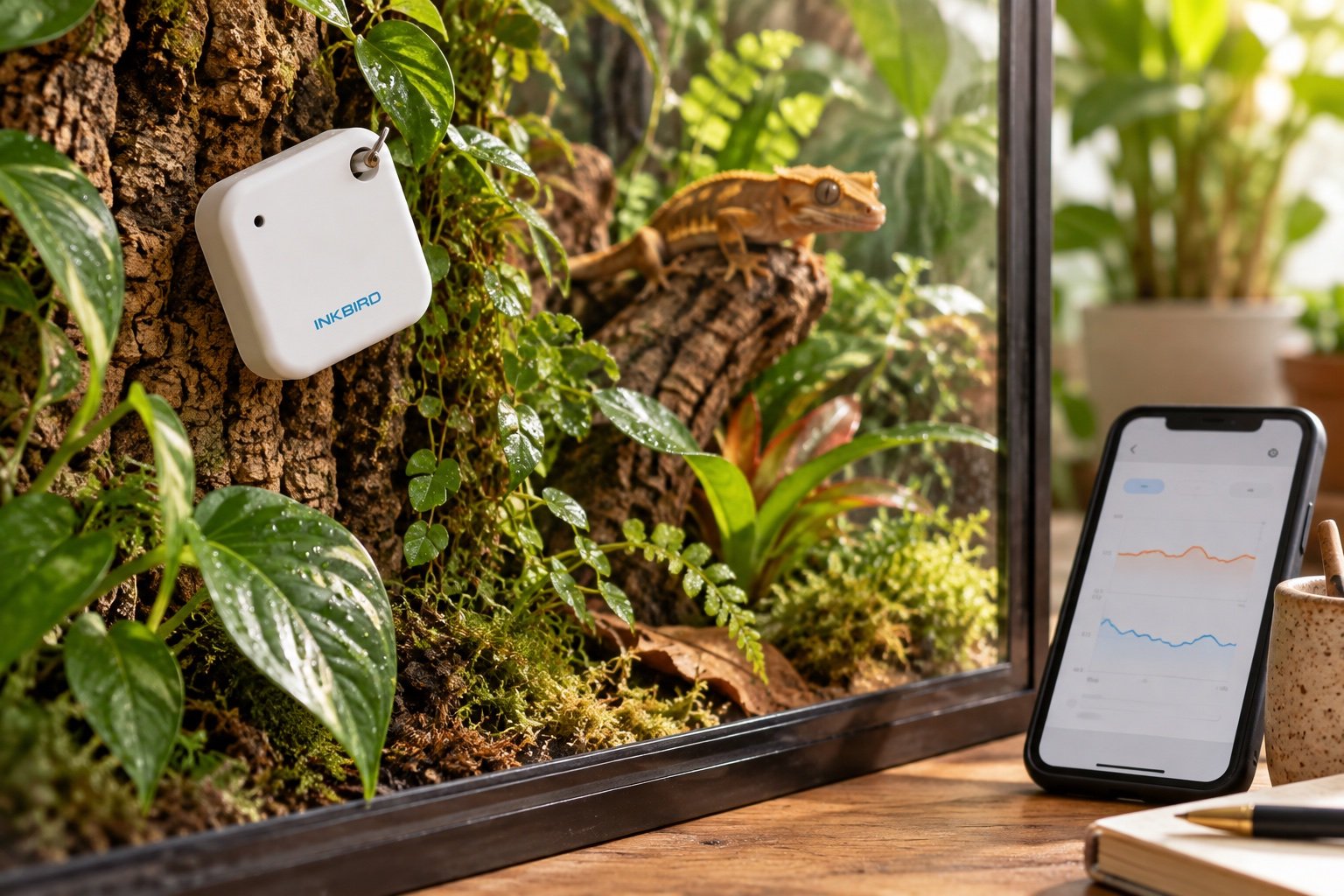
Quick verdict: The IBS-TH2 is an inexpensive local logger for enclosures where Bluetooth checks are enough. It stores plenty of history and supports offsets, but IPX4 is not permission to place it in a mist stream and it cannot deliver remote alerts without additional hardware.
We judge the device or method by the job it can repeat. Keep the thermometer and hygrometer guide and Govee H5075 review nearby while planning the setup.
| Point | What to know |
|---|---|
| Connection | Bluetooth, published range up to 30 m |
| Storage | Up to 30,000 offline data points |
| Protection | IPX4 |
| Power | 2 AAA batteries, claimed 3 to 6 months |
The missing screen is a tradeoff
You read the sensor through the app, so a quick room walk requires a phone. In return, the compact body can log without a bright display. Decide whether staff or family members need a value at a glance. If they do, the SwitchBot Meter Plus review covers a display-first alternative.
Bluetooth range shrinks around real racks
The 30 m figure is a planning maximum. Foil insulation, water, metal shelving and walls all reduce practical range. Walk the exact route with enclosure doors closed and confirm synchronization from the place you will actually stand. A logger that only updates when the phone is beside the glass still records useful history, but it is not a remote alarm.
Accuracy claims need a side-by-side check
Inkbird lists typical temperature accuracy of plus or minus 0.3°C and typical humidity accuracy of plus or minus 3% RH under stated conditions. Consumer sensors can still differ. Place two or three units together for a day, allow them to stabilize, then apply a documented offset only if the difference is consistent. Do not force every sensor to match a fast handheld reading.
IPX4 is splash resistance
Keep the body outside direct spray and away from standing water. Mount it where enclosure air reaches the vents without allowing an animal to climb on it or dislodge it. If the sensor is soaked, humidity recovery can be slow and the chart can exaggerate how long the habitat stayed wet.
Export before the history matters
Fill a week of data, export it and open the file. Check timestamps, units and sensor names. Repeat the process before replacing a phone or changing accounts. The data export and privacy guide applies to a temperature logger just as much as it does to a husbandry app.
What a good installation looks like after one week
The equipment should be boring. Cables remain where they were fixed, schedules occur at the expected local time and the animal can use the enclosure without touching a probe or blocking a sensor. Charts show ordinary cycles rather than unexplained steps. Alerts are rare enough that someone will act on them.
Repeat the acceptance check after major cleaning, seasonal room changes or firmware updates. If the system cannot recover cleanly from a routine interruption, it is not ready to become invisible infrastructure.
Keep a change log, even for a single enclosure
Record the date, old setting, new setting and reason. Add one observation after the next full day. This stops a sequence of sensible-looking tweaks from drifting far away from the original plan. It also helps another carer understand why an unusual schedule or position exists.
Firmware, app and clock changes belong in the same record as physical maintenance. After an update, confirm units, time zone, schedules, alarm limits and channel names. Do not assume a graph that looks familiar proves the outputs are mapped correctly.
Check the animal’s access around the hardware
Run a hand along the routes the animal can climb. Look for hot guards, sharp clips, adhesive edges and cable loops. Make sure a hide, plant or deep substrate cannot press against the sensor and create a false reading. Equipment placement is finished only when the animal can use the habitat normally without becoming part of the mounting system.
Observe the first week at ordinary care times, not only during a staged inspection. Feeding, misting, opening doors and moving bowls are the moments that disturb cables and airflow. If a control survives only when nobody touches the enclosure, it is not a durable installation.
Watch what happens during ordinary care
Open the enclosure, change water, mist, feed and move the usual hide or branch. Then check the hardware. Good installation survives those actions without a cable pulling tight, a probe moving or an alert becoming meaningless. A perfect result in an untouched display is less useful than a stable result during real care.
Ask another person to perform the round using the written labels. If they cannot identify the shutoff, correct sensor or affected habitat, improve the record. This is especially important when one controller or gateway serves several enclosures.
Plan the retirement path
Connected products eventually lose app support, batteries weaken and replacement probes disappear. Export data in an open format and keep essential settings in plain text. Avoid building a safety function that only one discontinued phone app can change.
Before replacing a working device, define the improvement you expect: quieter control, a second zone, remote alerts or better moisture protection. If the new product does not solve that specific limitation, maintenance and a spare part may be the better purchase.
Common mistakes
- Trusting the first stable-looking number without mapping the surrounding zone
- Changing several settings at once and losing the cause of the result
- Leaving probes, cables or mounts where normal animal movement can shift them
- Treating an app or remote alert as the primary safety control
- Skipping a power-recovery test because the device retained settings once
Related Reptile Tech Lab guides
- thermometer and hygrometer guide
- Govee H5075 review
- Wi-Fi vs Bluetooth sensors
- SensorPush G1 Gateway review
Frequently asked questions
Does the IBS-TH2 have Wi-Fi?
No. This model uses Bluetooth.
Can it sit under a misting nozzle?
No. IPX4 does not make direct spraying a good placement.
How much history can it hold?
Inkbird states up to 30,000 data points.
Can readings be calibrated?
The app supports offsets, which should be based on a stable comparison.