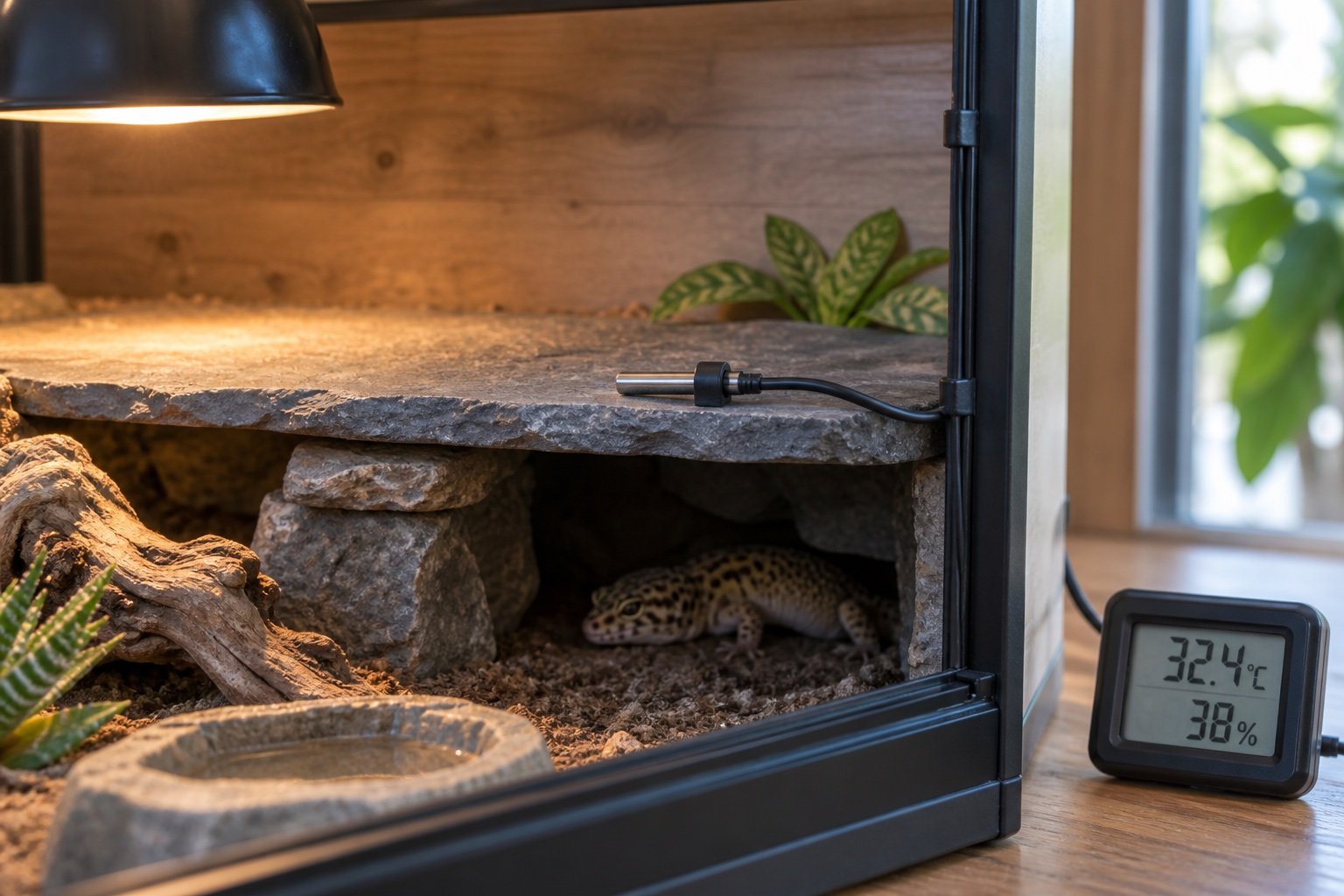
Quick verdict: Place the probe where it controls the hazard created by the heater, then use separate instruments to judge the rest of the habitat. A thermostat probe is not a general weather station. Its job is to keep one heat source inside a tested limit.
The useful comparison is the complete enclosure, not the number on the display. Our best reptile thermostats and IR thermometer vs probe provide the surrounding checks.
| Point | What to know |
|---|---|
| Basking lamp | Secure near the controlled basking surface |
| Heat mat | Fix at the warmed contact zone per system design |
| Air heater | Place in representative heated airflow |
| Verification | Use a separate sensor and surface checks |
Control the heater’s effect, not the prettiest number
A probe placed in the cool end produces a calm-looking reading while the basking zone overheats. A probe touching the lamp guard reacts too quickly and may leave the useful surface cold. Start by naming the surface or air mass the heater is meant to create. Place and restrain the probe there, then map nearby areas with the methods in our temperature gradient guide.
Restraint must survive the animal
Suction cups harden, tape lifts in humidity and curious reptiles move loose probes. Use a restraint appropriate to the enclosure material, keep adhesives inaccessible and protect cable runs from chewing or entanglement. A probe that can slide under substrate is not a fixed control point. Photograph the final position so cleaning staff can restore it.
Surface heat and air heat need different placement
A basking lamp creates a warm surface and a surrounding air gradient. Put the control probe according to the thermostat and heater design, then check surface temperature separately with an infrared tool. For a radiant panel or guarded ceramic emitter used as background heat, an air-oriented control point may be more useful. One location cannot describe both jobs.
Avoid a false cold reading
Direct mist, strong airflow or a probe pressed against cold glass can cause the thermostat to drive the heater harder. Watch the probe during a full misting and lighting cycle. If the reading drops sharply while the basking surface does not, move the sensor or change the system layout rather than compensating with a higher target.
Recheck after every physical change
A new hide, deeper substrate or moved branch changes the distance between the animal, probe and heater. Repeat warm-up tests with the habitat empty after major cleaning. Mark the cable and mounting point. This small record prevents a safe setup from drifting into a different one over several months.
A seven-day field check
Run the finished setup for a week before treating it as settled. On day one, photograph every position and record the room conditions. Watch the first warm-up and the final hour of the schedule. Midweek, compare the main reading with an independent instrument placed beside it long enough to stabilize. Near the end of the week, test a safe interruption such as a network loss or short power cut.
Do not tune settings every time a single reading looks odd. Look for a repeated pattern and change one variable. A clear notebook entry is more useful than a folder of screenshots with no explanation.
Separate a useful alert from ordinary noise
Set warnings far enough from normal cycling that they mean something, but early enough to allow a response. Review a full week of data before tightening limits. Misting peaks, nighttime drops and door-open care periods may be expected. Label those events in the record so they are not mistaken for hardware faults.
Every alarm needs a person, a time window and an action. If nobody can reach the enclosure, a remote notification mainly documents the problem. Keep contact details and the safe immediate steps with the care instructions, then test the alert on another network.
Use independent evidence for the important claim
If a thermostat says the basking zone is safe, confirm the surface with the correct instrument. If a logger claims the room stayed stable, compare it with a second sensor during commissioning. If an app says a schedule ran, observe the actual lamp, fan or pump. Independent checks should use a different device and, where possible, a different power path.
Agreement once is not proof forever. Recheck after moving decor, replacing a bulb, changing substrate depth or altering room heating. Those changes can affect the habitat more than a small adjustment inside the app.
Check the setup at two room temperatures
A controller that behaves well on a mild afternoon may struggle during the coldest night or hottest sunny day. Repeat the map when the room changes naturally. Do not create dangerous conditions for a test, but use seasonal weather to confirm that the system has enough capacity and still leaves a cool retreat.
Room data helps explain enclosure data. Place a temporary logger outside the habitat while commissioning and note HVAC cycles, open windows and direct sun. Remove it later if it adds no actionable information.
Know which number deserves action
Small consumer-sensor differences are normal. Focus on repeated drift, missed cycles and values that cross a husbandry or equipment limit. Write the action beside the threshold: inspect a probe, disable one heater, call the local carer or move the animal to the prepared backup.
An alarm with no response rule becomes background noise. Test delivery, acknowledge it and record how long the response took. Then adjust the threshold only if the normal data shows that it is poorly placed.
Common mistakes
- Trusting the first stable-looking number without mapping the surrounding zone
- Changing several settings at once and losing the cause of the result
- Leaving probes, cables or mounts where normal animal movement can shift them
- Treating an app or remote alert as the primary safety control
- Skipping a power-recovery test because the device retained settings once
Related Reptile Tech Lab guides
Frequently asked questions
Should a thermostat probe be inside the enclosure?
Usually the sensing end must measure the controlled zone, while the controller and mains parts remain safely outside.
Can it hang loose in the air?
A loose probe can move and change control behavior. Secure it.
Should it touch the basking surface?
Follow the heater and thermostat instructions, then verify both probe reading and actual surface temperature.
Do I still need another thermometer?
Yes. Independent monitoring can reveal a displaced probe or controller fault.