Editorial note: this review covers the current Herpstat 1 SpyderWeb model using its published manual and product specifications. It does not invent bench-test results. Verify the exact regional model, firmware and electrical rating before setup.
Verdict: Herpstat 1 SpyderWeb is expensive for a single output, yet its control and safety design explains the price better than its Wi-Fi features do. Proportional heating, a removable probe, an internal safety relay, audible alarms, outage tracking and retained settings make it a serious controller before the network is even configured. Remote status and graphs are useful extras, not the foundation.
It is best suited to a keeper who wants one carefully controlled heat zone and will spend time testing probe placement. Someone running several enclosures should price the appropriate multi-output Herpstat rather than buying a row of single-channel units. A simple heat mat in a stable room may not need this much control.
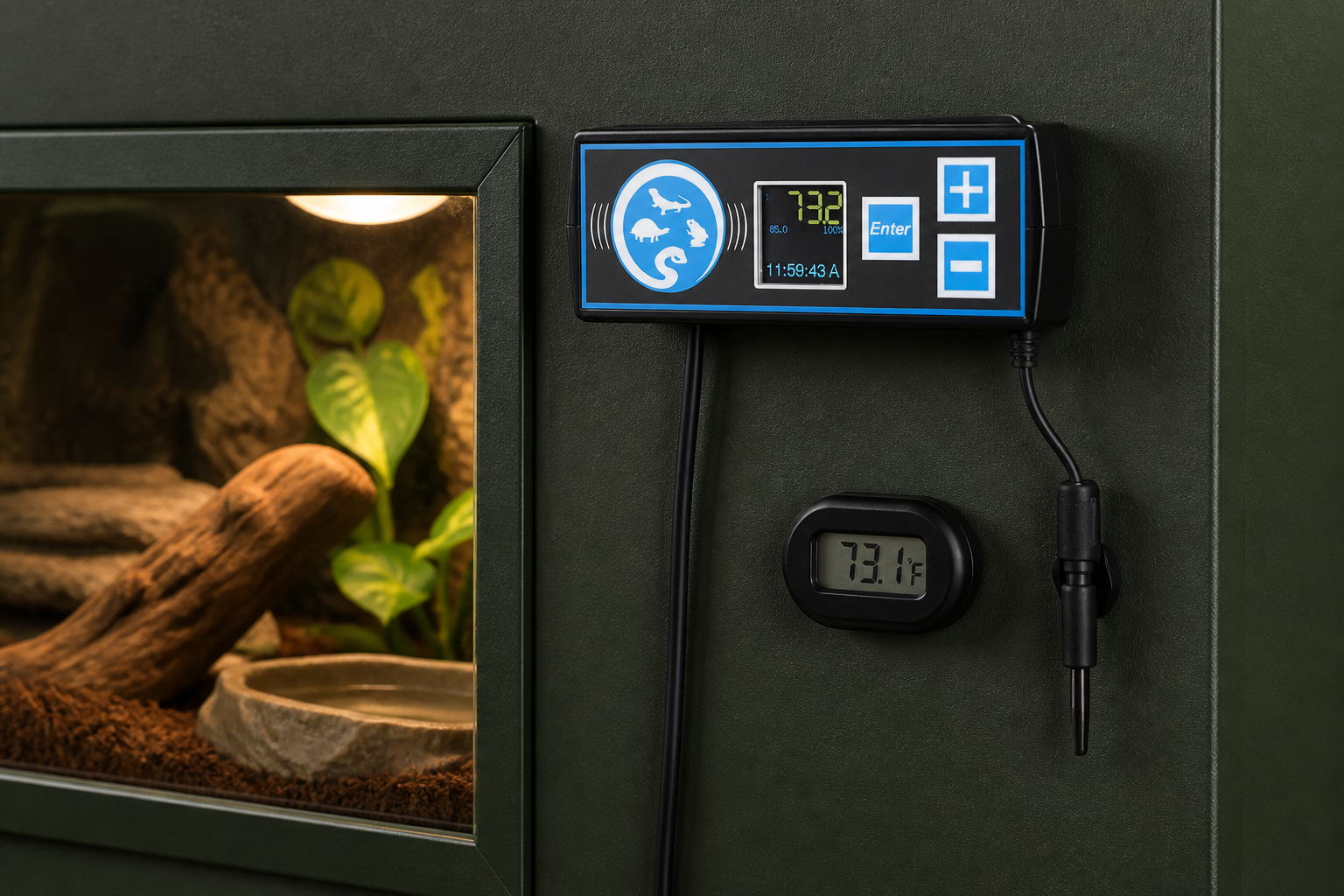
Herpstat 1 specifications that matter
| Outputs | One controlled output |
|---|---|
| Published load | 700 watts total on the current SpyderWeb product page |
| Temperature range | 40 to 150°F, or 4 to 65°C |
| Control options | Heating, cooling, lighting or humidity configuration; proportional heating support |
| Scheduling | Up to four temperature periods per day |
| Probe | Removable steel-tipped temperature probe; optional humidity probe |
| Network tools | Local browser view, remote monitoring, graphing, status and emergency email options |
| Safety | Sensor-failure shutdown, audible alarm, thresholds, replaceable fuse and internal safety relay |
Why proportional control feels different
A basic thermostat waits for the probe to cross a threshold, turns the heater fully off, then applies full power after the temperature falls. Herpstat can reduce output as the enclosure approaches the target. The heater spends less time lurching between zero and full power, although the final stability still depends on heater type, enclosure mass, room temperature and probe location.
Soft startup applies power gradually during an initial warmup. Auto Power Matching then adjusts the output curve to the enclosure’s behavior. Neither feature removes the need for an empty-enclosure test. A large stone hide may continue releasing heat after the controller cuts output, while a light PVC enclosure can respond quickly.
The comparison of the best reptile thermostats explains when dimming, pulse and on/off control fit different heaters. Never assume proportional means compatible with every lamp.
Four daily periods are useful when they stay simple
Herpstat permits up to four scheduled settings each day. That can create a gradual morning warmup, daytime target, evening decline and overnight level. It is more flexible than a single day/night switch, but four periods are not automatically more natural.
Start with two temperatures. Add another period only when it solves a measured problem, such as preventing a sharp transition caused by the room’s HVAC schedule. Record the actual enclosure response for several days. The temperature at the probe can follow the program while the basking surface lags behind.
Lighting mode can simulate sunrise, sunset and moonlight, but an animal’s lighting plan also depends on UVB, visible illumination and darkness. Do not let one controller screen turn several separate husbandry decisions into a single number.
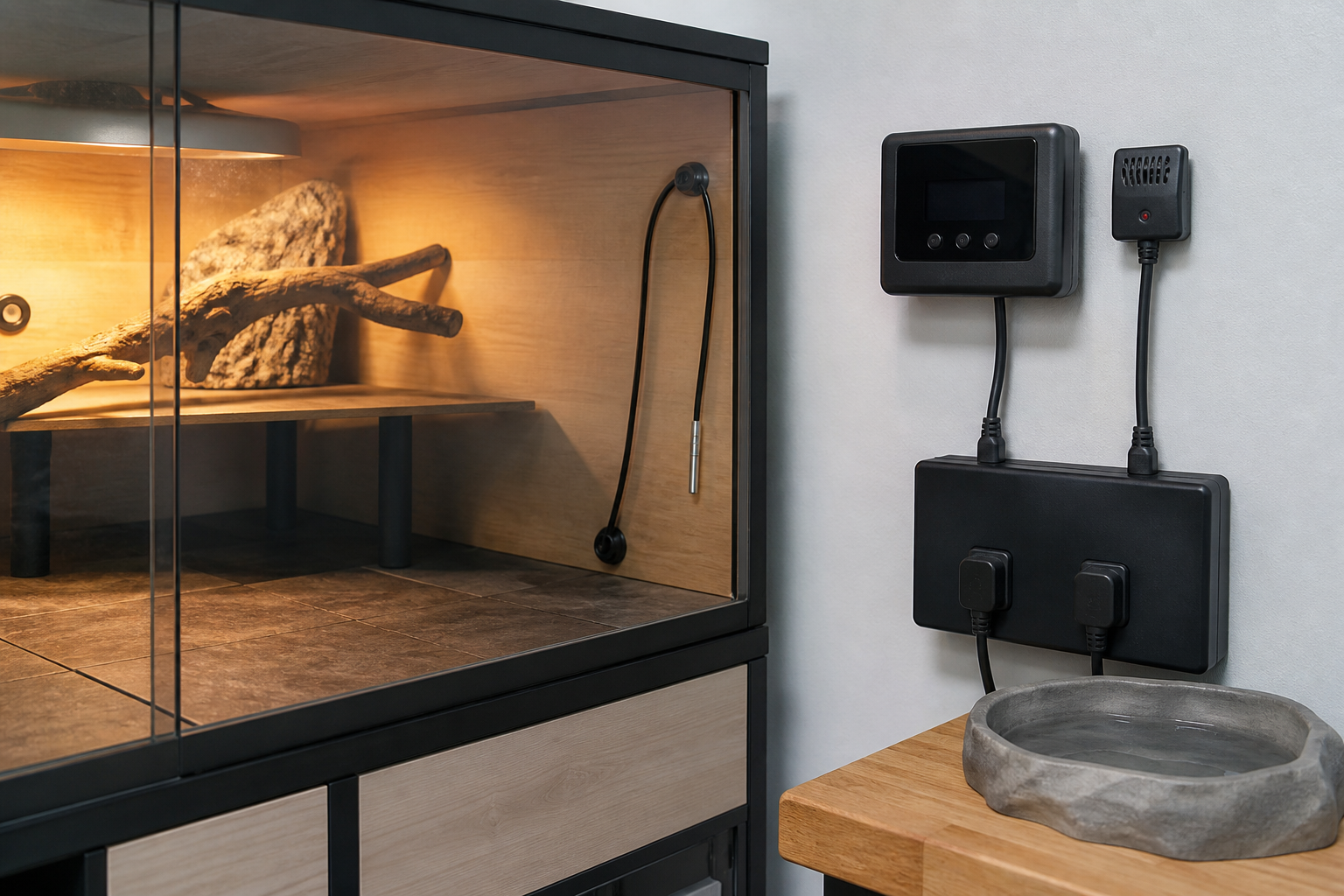
Probe placement and sensor matching
The removable probe is one of the strongest ownership details. Cables get pinched, chewed and pulled. Replacement is easier when the sensor is not permanently attached to the controller. Secure the tip at a repeatable point where the animal cannot drag it under a hide or press it against the heater.
Sensor Matching lets the displayed temperature be adjusted against another instrument. Calibration should not be used to make an inconvenient reading disappear. Put the Herpstat probe and a trusted reference together in a stable environment, wait for both to settle, compare several points and document any offset. A single reading beside an active lamp is a poor calibration test.
Use independent monitoring after calibration. The thermometer and hygrometer guide covers response time, sensor placement and data logging. An infrared thermometer is useful for surfaces but does not calibrate an air probe by itself.
The safety system is the real reason to upgrade
Spyder Robotics lists internal error detection that shuts off heat when the sensor fails or disconnects. The controller also has selectable high and low thresholds, an audible alarm and a separate internal safety relay that can remove power under user-defined conditions. Those layers address different faults.
Test alarms with the enclosure empty. Set a temporary threshold close to room temperature, confirm the audible alert, then restore the proper value. If the manual permits, disconnect the probe and verify the output turns off. Do not improvise a short circuit or open the controller.
All settings are retained after power loss, and the unit tracks outages. Pulling power for a controlled test tells you more than the feature list. Confirm the clock, schedule, setpoint, output mode and Wi-Fi behavior after restart. A thermostat that resumes heat correctly but forgets its clock can still run the wrong temperature period.
SpyderWeb remote monitoring
The controller can expose status through a local web view and upload data for remote access. It also supports history graphs, scheduled status emails and emergency emails. This is useful for spotting a slow room-temperature drift or checking whether an outage happened while nobody was present.
Remote monitoring has several independent failure points: router, internet service, email delivery, cloud account and phone notification settings. Keep local audible alarms enabled. If remote alerts are important, deliberately interrupt Wi-Fi and learn what the controller shows and what message, if any, arrives.
Use a unique network password and install firmware only through the manufacturer’s supported process. Do not expose a local controller interface directly to the public internet. Remote access is convenient, but the device’s safe local behavior matters more.
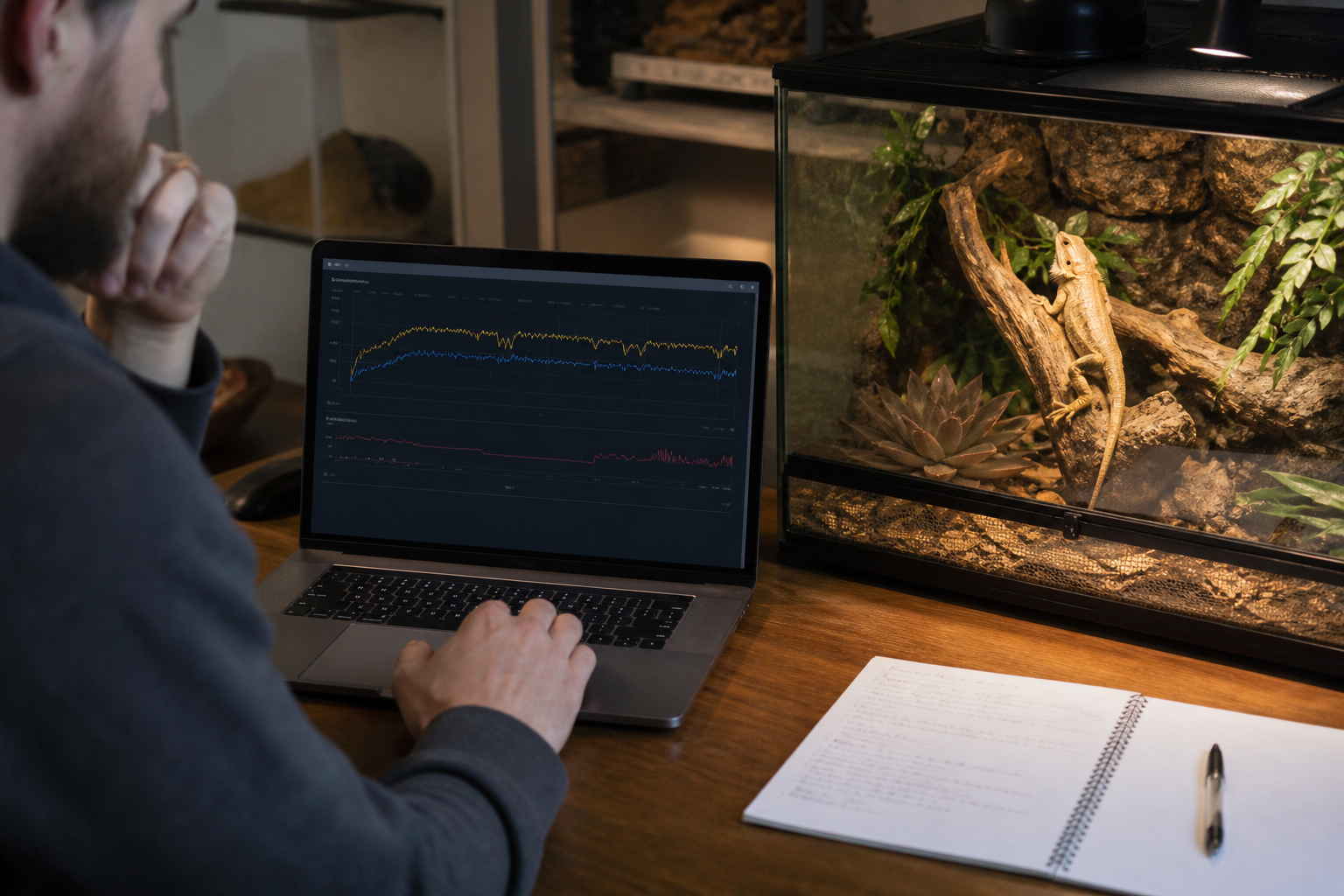
History graphs: useful evidence, limited diagnosis
A graph can reveal cycling, overshoot, room-driven drift and warmup time. It cannot explain every change. A moved probe, open door, misting cycle and fresh substrate can produce similar-looking dips. Keep short notes when the enclosure changes so the graph has context.
Compare the controller history with an independent logger for several days. The two sensors should not be expected to match perfectly if they occupy different points. The goal is to understand the gradient and catch sudden disagreement, not force every display to show the same decimal.
Installation workflow
- Mount the controller and all mains connections outside the enclosure and away from spray.
- Install the heat source in its final guarded fixture.
- Secure the Herpstat probe at the control point with a cable route the animal cannot disturb.
- Connect only a compatible load below the regional unit’s rating.
- Set control mode, target, alarms and a simple schedule.
- Place independent sensors at the controlled point and cool end.
- Run the finished enclosure empty for at least a complete day/night cycle.
- Test outage recovery and the supported sensor-failure response.
- Configure remote access only after local control is proven.
Keep sockets raised and use drip loops. A misting nozzle should never spray the controller, receptacle or cable entry. The misting system comparison includes electrical separation and leak checks.
Where Herpstat 1 falls short
The first limitation is obvious: one output. It cannot independently control two enclosures or two heat zones. A splitter lets one probe switch several devices together, which is not the same thing. Choose a multi-output controller when the zones need separate feedback.
The interface asks more from the owner than a basic plug-in thermostat. Four periods, several modes, matching, thresholds and network settings create more places for a configuration mistake. Write down the final setup and keep the manual nearby.
Price also matters. If the heater works safely with simple on/off control and an independent alarm already covers the room, the upgrade may add little. The Herpstat vs Inkbird ITC-308 guide compares the two control classes without pretending they are equivalent products.
Who should buy it?
Herpstat 1 makes sense for a high-value animal, a temperature-sensitive setup, a fast-heating enclosure or any keeper who wants local safety layers plus a readable history. It also suits people who will test alerts and power recovery instead of assuming the network makes the enclosure safe.
Choose something simpler when the heating load is modest, on/off behavior is acceptable and remote data will not be used. Choose a larger Herpstat when multiple independent zones are already planned. Buying the correct number of channels at the start is usually cleaner than stacking adapters later.
Frequently asked questions
Does Herpstat 1 work without Wi-Fi?
Yes. Spyder Robotics states that network features are not required for thermostat operation. Configure and test local control first.
Can Herpstat 1 control humidity?
The current SpyderWeb model can be configured for humidity with an optional humidity probe. Check compatibility and do not assume one output can heat and humidify independently at the same time.
What happens if the temperature probe fails?
The manufacturer describes internal detection that shuts off heat if the probe fails or disconnects. Test only by the safe method in the manual.
Can it control two heaters?
It has one controlled output. Two devices on that output would share one probe and one control signal. Independent zones need independent outputs and probes.