Verdict: Herpstat 1 and Inkbird ITC-308 are not cheaper and dearer versions of the same thermostat. Herpstat is a reptile-focused proportional controller with one output, scheduling, replaceable sensing hardware, detailed alarms and an independent safety relay. The ITC-308 is a general-purpose two-stage on/off controller with separate heating and cooling sockets. Choose by heat source and failure behavior, not by the number on the price tag.
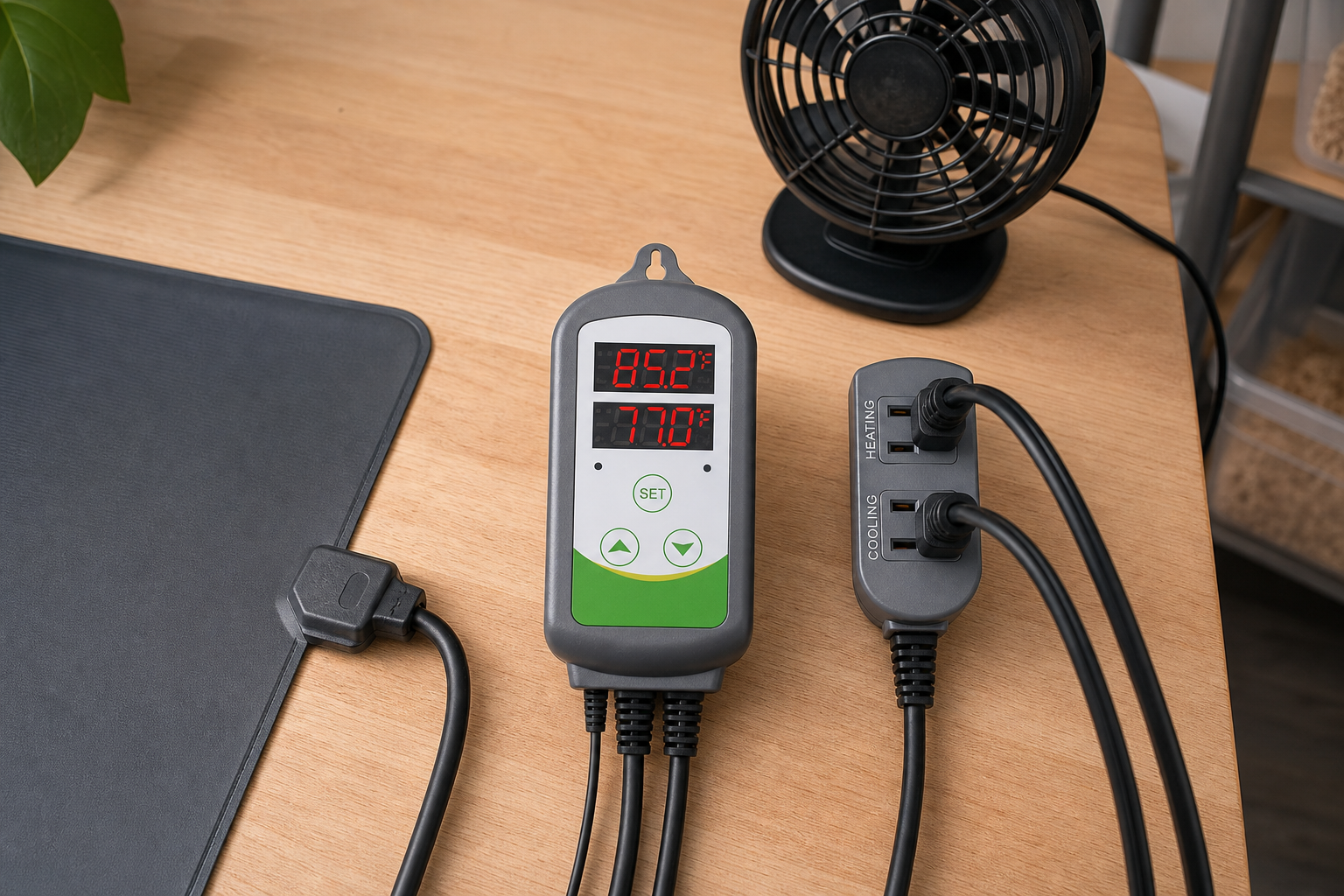
Side-by-side comparison
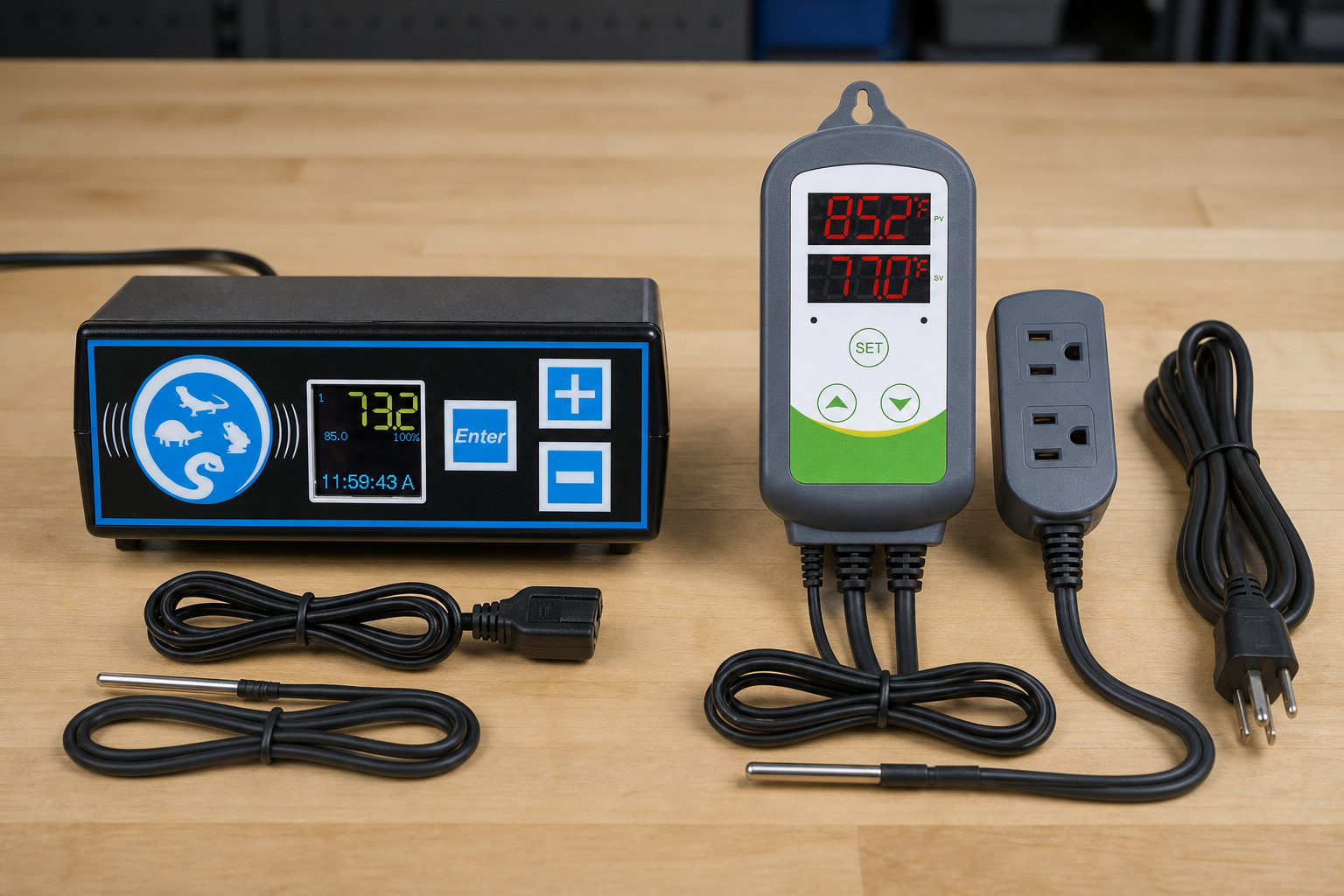
| Question | Herpstat 1 SpyderWeb | Inkbird ITC-308 |
|---|---|---|
| Control style | Proportional heating plus configurable modes | On/off heating and cooling with adjustable differentials |
| Outputs | One controlled output | Separate heat and cool receptacles driven by one probe |
| Schedules | Up to four daily temperature periods | No reptile-specific day/night program on the standard model |
| Probe | Removable steel-tipped sensor | Attached NTC sensor on standard ITC-308; detachable on some related models |
| Published load | 700 watts total | 10A total; watt figure varies with regional voltage and listing |
| Remote option | Local and remote web status, graphing and email features | Standard and Wi-Fi variants are sold |
| Safety emphasis | Audible alarms, sensor shutdown and internal safety relay | High/low and sensor alarms, calibration and compressor delay |
Herpstat wins when the heater needs proportional control
Herpstat reduces power as the probe approaches the target. This can hold a compatible heater close to setpoint without the broad cycles produced by an on/off controller. Soft startup and Auto Power Matching help the controller learn the thermal response, though they cannot compensate for a badly placed probe.
A light-emitting basking lamp normally needs smooth dimming rather than visible pulsing or repeated hard switching. Confirm the chosen Herpstat mode and lamp compatibility in the manual. The broader guide to reptile thermostats maps dimming, pulse and on/off control to common heat sources.
Inkbird wins when simple two-stage switching fits
The ITC-308 can turn a heater on below one threshold and a cooling device on above another. That is useful for a conditioned reptile room, incubator cabinet or equipment bay where a heater and fan need coordinated on/off control. Compressor delay also makes sense when the cooling device contains a compressor.
For one heat mat in a stable room, the Inkbird’s simple setup may be enough. For a visible lamp, its relay switching is usually the wrong behavior. Do not choose it merely because the total load rating is high.
Temperature stability depends on the enclosure
An on/off controller does not automatically create dangerous swings. A low-power mat under a heavy enclosure may change slowly. A powerful radiant heater in a light enclosure can overshoot after the relay opens because stored heat continues moving toward the probe.
Herpstat’s finer output control can reduce that cycle, but only at the measured point. Run either controller with the complete enclosure empty. Log warm surface, warm-side air and cool-side air through a full day. The temperature monitoring tools guide explains why a thermostat display, infrared reading and air logger answer different questions.
Probe design and replacement
Herpstat includes a removable probe, which makes damage easier to repair. The standard ITC-308 uses an attached probe; Inkbird’s ITC-308S is a related model with a plug-in probe. Read the model label before ordering a replacement.
Inkbird describes the ITC-308 probe as IP68, but the controller body and sockets are not waterproof. Herpstat also belongs outside the enclosure. Keep every mains connection above the floor, away from spray, and protected by a drip loop.
Alarms and failure response
Both products publish high and low alarm functions. Herpstat adds a separate internal safety relay, power-outage tracking and a defined sensor-failure heat shutdown. Its audible alarm works locally, while SpyderWeb email adds another path.
Inkbird provides a buzzer for temperature limits and sensor faults. The Wi-Fi variant can add remote visibility, but an app alert is not an independent cutoff. Test each alarm locally and verify what the output does when the sensor is disconnected using the manual’s safe procedure.
Schedules and day/night temperatures
Herpstat supports four periods per day, enough for morning, daytime, evening and night targets. Start with two. More transitions create more ways to enter the wrong time or temperature.
The standard ITC-308 is built around heating and cooling differentials rather than reptile lighting cycles. A separate timer may control lighting, but it should not bypass thermostat protection. If a night drop is required, use a controller designed to schedule it or a documented system that keeps the heat source under safe control.
Remote monitoring
Herpstat SpyderWeb provides browser status, graphs, scheduled emails and emergency email options. These are useful for checking warmup time and identifying outages. They depend on the router, internet and mail delivery.
Inkbird sells a Wi-Fi ITC-308 with app control. That model has different published ranges in some markets, so do not copy specifications from the non-Wi-Fi page. With either product, local control must remain safe when the network disappears.
Cost comparison
The ITC-308 costs far less. That is real value when on/off control is appropriate. Herpstat’s extra cost buys a different control method, reptile-oriented scheduling, replaceable sensing, more safety hardware and deeper history. Paying for those features only makes sense if the setup uses them.
Price the complete system: controller, independent logger, correct lamp holder, guards, spare probe and remote gateway if needed. The cheapest controller can become expensive when it forces another purchase to provide an alarm or day/night schedule.
Which one should you buy?
- Choose Herpstat for a single important enclosure, a compatible radiant heater, day/night scheduling and stronger local safety layers.
- Choose Inkbird for simple heat-mat control, a cabinet heater, or coordinated heating and cooling where relay switching is acceptable.
- Choose neither if you need two independent heat zones. Buy a controller with separate channels and probes.
- Choose a dedicated dimming thermostat if the selected Herpstat model or mode does not support the visible lamp exactly as required.
Setup test for either controller
- Confirm voltage, current, wattage and heater compatibility.
- Secure the probe at the real control point.
- Place independent sensors beside it and at the cool end.
- Run the finished enclosure empty for at least one day/night cycle.
- Test alarm thresholds, probe failure and power recovery according to the manual.
- Record the final settings and photograph the cable routing.
Read the full Herpstat 1 review for its schedules and SpyderWeb limits. Pair either controller with an independent device from the thermometer and hygrometer comparison.
How each controller behaves during a fault
A comparison is incomplete until the probe is deliberately disconnected during a supervised test. The controller should move to its documented safety state, sound or display an alarm, and avoid driving the heater continuously. Repeat the exercise with the probe placed briefly against a cooler surface. This shows how a loose probe can create a more dangerous false reading than a clean disconnection.
Test power recovery too. Unplug the controller, wait, reconnect it and verify the set point, schedule and alarm limits. A remote monitor should be separate from the control probe so it can report a disagreement. Our overview of reptile temperature monitoring tools explains that independent layer.
Running cost and heater wear
Purchase price is only one part of the decision. On/off control repeatedly switches a heater at the edges of a differential. For a low-inertia device, this can produce frequent cycles and a visible temperature sawtooth. Proportional control supplies only the output needed near the target, which can feel calmer in a basking setup and avoids full-power bursts.
That does not mean proportional control is automatically cheaper to operate. The enclosure’s heat loss determines most energy use. The practical benefits are control behavior, lamp output and temperature stability. Record the room temperature with enclosure readings when comparing controllers, because a cold room can make either unit appear less capable.
Using either unit in a multi-enclosure room
Label the plug, probe and enclosure as one set. Similar black leads are easy to cross during cleaning. Mount the display where it can be read without opening the enclosure and keep the controlled receptacle inaccessible to animals and water. If several controllers share a circuit, total the maximum load and leave margin for startup and other room equipment.
For multiple habitats, consistency is more valuable than clever settings. Use a written commissioning checklist and record set point, probe position, heater type and alarm test. This complements the workflows in our guide to managing a large reptile collection.
Frequently asked questions
Is Inkbird safe for reptile heat lamps?
The standard ITC-308 uses on/off relay control. That can cause visible cycling and is usually not the preferred method for a basking lamp. Use a compatible dimming controller.
Can Herpstat heat and cool at the same time?
Herpstat 1 has one controlled output, so it cannot independently run one heater and one cooler. The ITC-308 has separate heat and cool receptacles controlled from one probe.
Which controller is more accurate?
Published sensor accuracy does not tell the whole story. Control method, probe position, differential and enclosure inertia determine the temperature the animal experiences.
Do remote alerts replace a room alarm?
No. Network and cloud alerts can fail. Keep local alarms and independent monitoring in the safety plan.