Editorial note: this review covers the current manufacturer specification and repeatable enclosure technique. UV requirements vary by species, life stage and setup. Use qualified husbandry guidance and veterinary advice where health is involved.
Verdict: Solarmeter 6.5R is the most useful handheld meter for reptile keepers who need to measure UV Index at the animal’s position. It does not tell you whether a lamp is good in every respect, and it does not measure visible brightness or heat. Its value comes from turning lamp distance, mesh loss and aging into repeatable numbers.
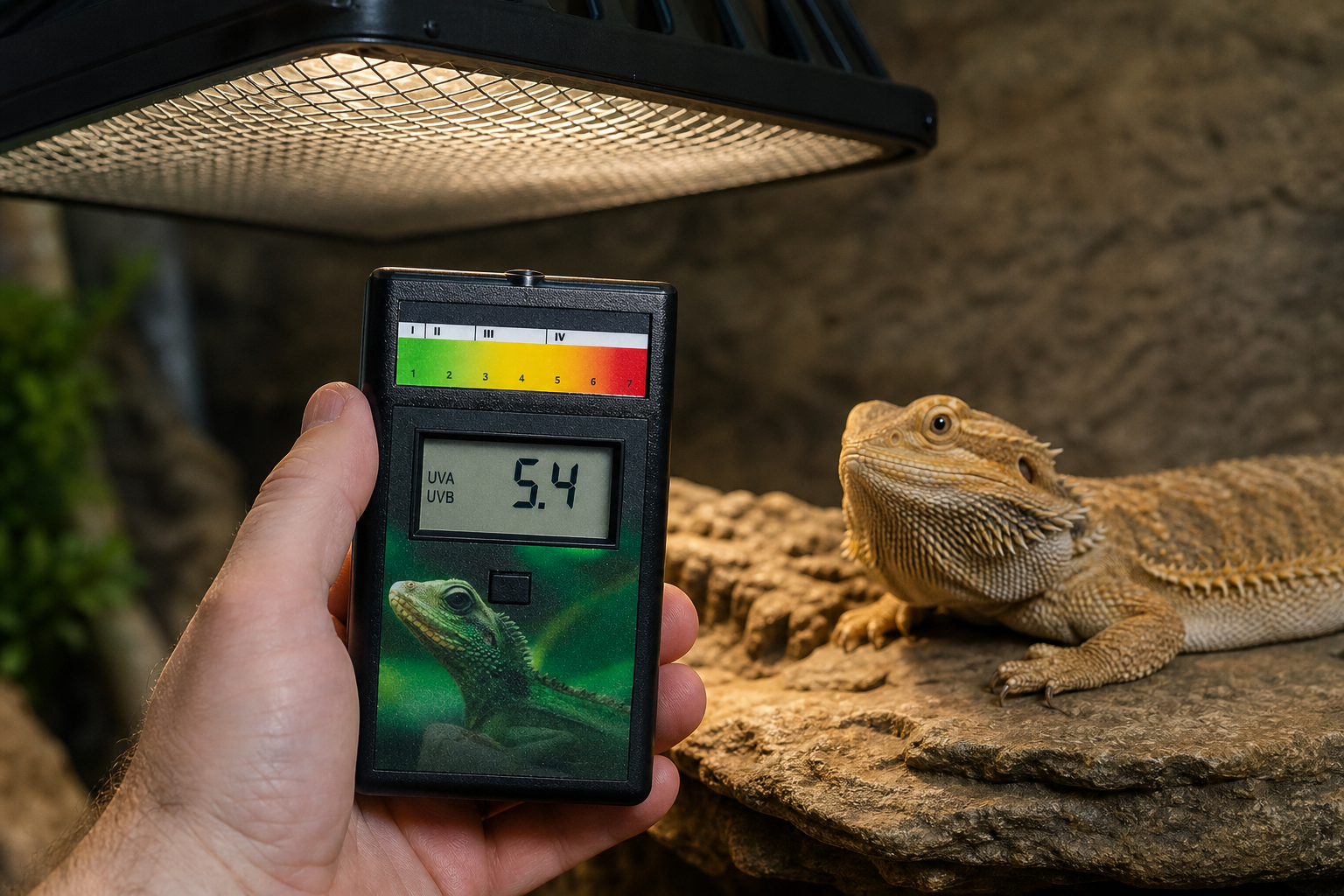
What the 6.5R measures
| Output | UV Index, resolution 0.1 |
|---|---|
| Published range | 0 to 199.9 UVI |
| Spectral response | 280 to 400 nm with a Diffey erythemal response |
| Reading rate | Three readings per second |
| Published accuracy | ±10% relative to NIST reference |
| Power | 9-volt battery |
| Operating range | 0 to 32.2°C and 5 to 80% RH |
The 6.5R is operationally the same as the established Model 6.5, with reptile-focused graphics. It reports an index weighted by biological effect. The number is more useful for enclosure planning than a raw microwatt reading when the question is the UV exposure available to the reptile.
6.5R versus 6.2R
Model 6.5R reports UV Index. Model 6.2R measures UVB irradiance in microwatts per square centimeter. They are not interchangeable scales and no universal conversion works across different lamp spectra.
Most keepers choosing one meter should start with 6.5R because many modern reptile-lighting recommendations use UVI and Ferguson Zone concepts. Lamp manufacturers and researchers may use a 6.2R for additional output measurements. Buying both does not help unless you know how the second result changes a decision.
How to take a useful reading
- Warm the lamp for the period specified by its manufacturer.
- Build the enclosure exactly as used, including reflector, mesh and guards.
- Hold the meter at the animal’s accessible body position.
- Aim the sensor toward the center of the lamp without shading it.
- Keep orientation and distance repeatable.
- Measure the basking center, edges, retreat and cool side.
- Record lamp model, age, fixture, mesh, distance, date and UVI.
One reading directly under a bare lamp is not an enclosure map. The reptile encounters a gradient. Measure where its back, head or shell can actually sit, not the substrate when the animal’s body rises several inches above it.
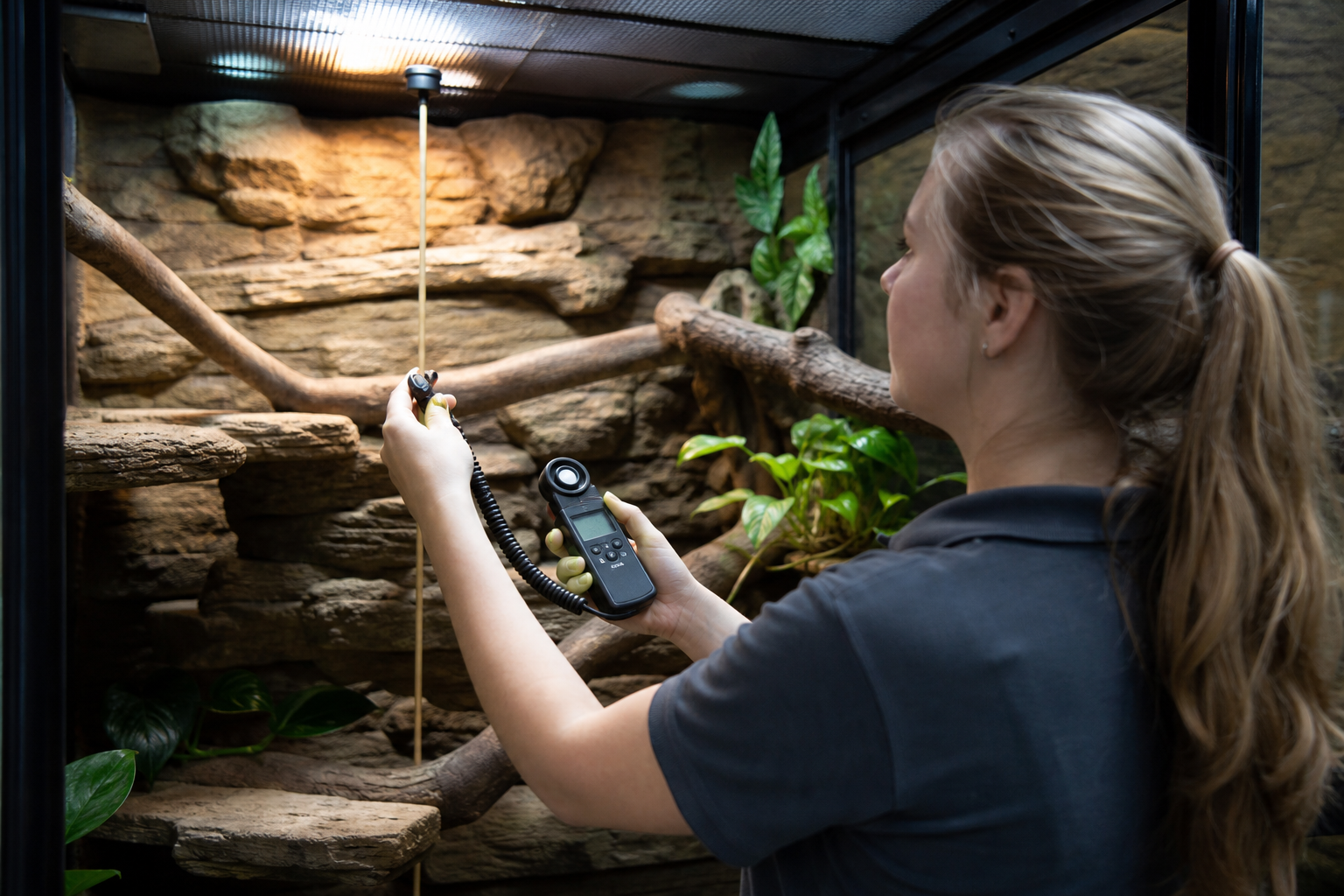
Mesh and distance can change the answer
Screen mesh absorbs and scatters part of the output. The loss depends on wire thickness, spacing, coating and distance. A generic percentage from another enclosure is less reliable than a measurement above and below your own screen.
Distance has an equally large effect. Move the meter in small, measured steps and create a table. Do not raise a branch after testing without checking the new animal position. A small construction change can matter more than the age printed on the lamp box.
Use it to track lamp aging
Record a baseline after a new lamp settles through its initial operating period. Repeat at the same locations monthly or at another sensible interval. Replace by measured performance and manufacturer guidance, not appearance. A lamp can continue producing visible light after useful UV output declines.
Keep the reflector clean and note every change. A new fixture, different mesh or moved branch resets the baseline. The environmental monitoring guide uses the same principle: record the setup with the number.
Repeatability matters more than chasing decimals
The display resolves to 0.1 UVI, but hand position and angle can move the value. Make three readings at each point and record a stable value or short range. A cardboard jig or marked measuring stick can keep distance and orientation consistent.
Do not compare readings taken through different glass, mesh or plastic. Ordinary glass blocks much of the relevant UV. Measure inside the actual barrier configuration while keeping the meter within its operating humidity and temperature range.
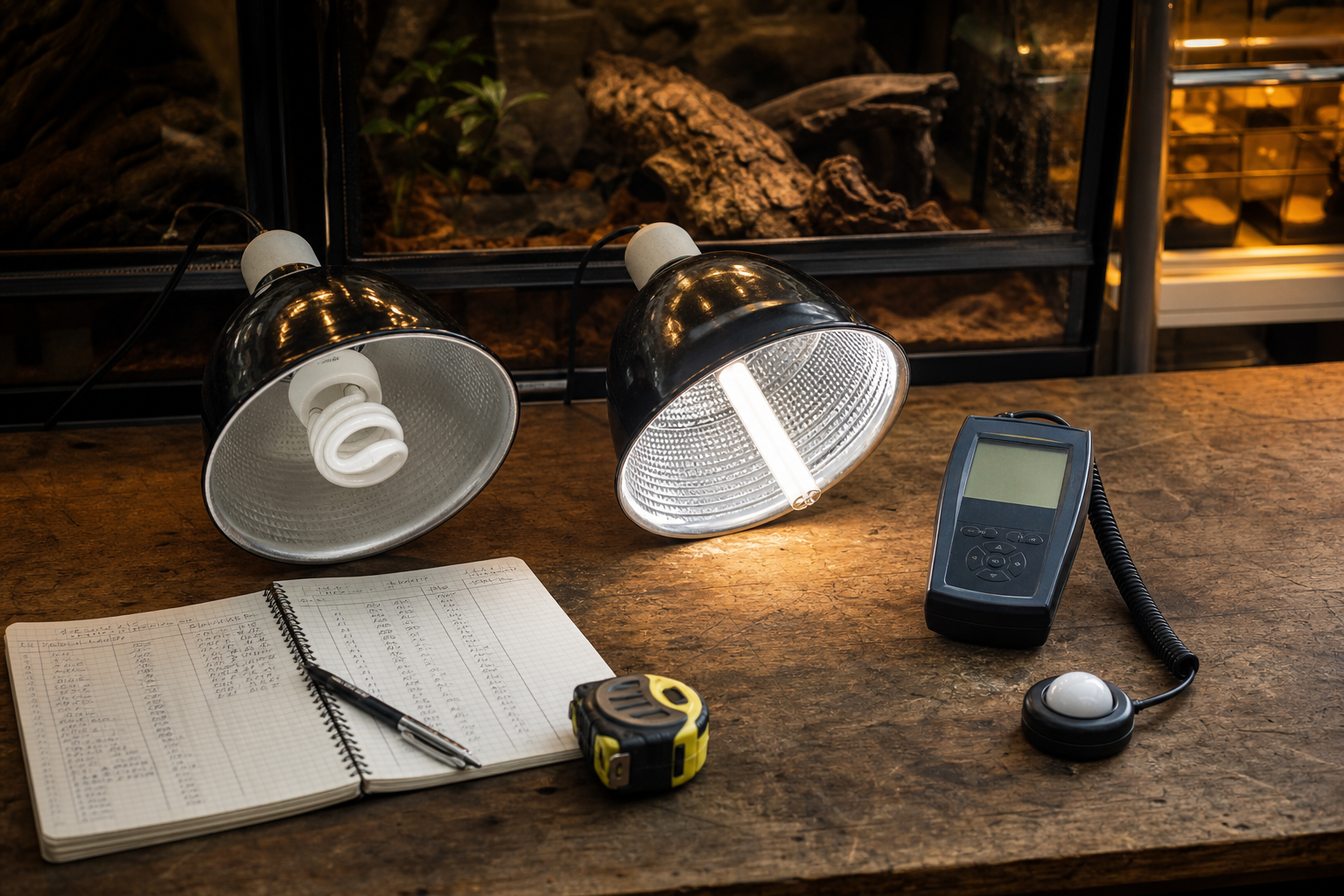
What the meter cannot tell you
It cannot identify the correct UVI for an animal by itself. It cannot measure temperature, visible light quality, photoperiod or the size of the usable basking zone. It also cannot diagnose disease or prove adequate vitamin D status.
A safe setup combines species-appropriate UVI guidance with a suitable heat gradient, bright visible light and places to escape exposure. The best number at one point does not rescue an enclosure with no shade.
Cost and ownership
The 6.5R is expensive compared with a thermometer because its filtered sensor and calibration solve a narrower measurement problem. The price is easier to justify across several UV-equipped enclosures, for a breeder, rescue or club that shares a meter.
Store it dry, protect the sensor window, remove the battery for long storage and follow the manufacturer’s recalibration guidance. Do not touch or clean the optical surface with an aggressive product.
A practical UV log
| Date | Lamp and age | Fixture/mesh | Point | Distance | UVI |
|---|---|---|---|---|---|
| YYYY-MM-DD | Model, hours/months | Reflector and screen | Basking center | Measured to sensor | Stable reading |
Photograph the measuring position. A number without position is hard to reproduce. Link the log to the animal or enclosure ID using the ideas in the QR record guide.
Who should buy it?
Buy the 6.5R if you run UVB lamps, change fixtures or screens, manage several enclosures, or want evidence for replacement timing. It is especially useful for tall arboreal setups and rescues where lamp history is uncertain.
A keeper with one established enclosure may borrow or share a calibrated meter, provided readings are repeated after changes. Do not buy a cheaper unverified UV gadget only because its display has more digits.
Build a measurement map, not a single number
A useful UV check covers the places the reptile can actually occupy. Start at the highest point of the basking surface, then measure the center and both edges. Repeat at the animal’s normal head height. Finish with readings in shaded retreats and along the route between warm and cool areas. This creates a small map of choices instead of one impressive number directly under the lamp.
Keep the meter in the same orientation for every point. Small changes in angle can matter under compact lamps and narrow reflectors. If the animal can climb, include branches, ledges and the top of hides. A branch that looked safely below the lamp can become the highest exposure point after the enclosure is rearranged.
Commissioning a new UVB lamp
Do not wait until the replacement date printed on a calendar. Measure a new lamp after it has settled into normal operation, with the final reflector, mesh and furnishing layout installed. Save that baseline with the lamp model, installation date, distance and meter position. Repeat the same map after one week, monthly for the first quarter and then on a schedule that fits the collection.
A sudden change is often more useful than the absolute reading. It can reveal a moved fixture, dirty reflector, shifted branch or failing lamp. If the reading falls, clean and inspect the setup before replacing parts. The goal is to find the reason, not merely restore a favorite number.
Care, storage and calibration
The sensor window should stay clean, dry and protected from scratches. Store the meter away from misting equipment and do not leave it in a hot reptile room window. Before an important survey, check the display and battery, then take one reading at a familiar reference point. An unexpected reference reading is a reason to repeat the setup before making husbandry changes.
Solarmeter offers calibration service, which matters for a tool used over many years. Note the service date in the same log as lamp measurements. For a multi-enclosure collection, label the meter case with a simple measurement routine so different keepers hold and position it consistently.
Frequently asked questions
Does Solarmeter 6.5R measure UVB?
Its sensor responds across 280 to 400 nm and reports UV Index using an erythemal weighting. It does not display raw UVB irradiance like the 6.2R.
Can I measure through glass?
Measure the exposure inside the real enclosure barriers. Glass blocks much UV and a reading outside the glass does not represent the animal’s position.
How often should I test a lamp?
Record a new-lamp baseline, then repeat on a regular schedule and after any change to lamp, fixture, distance, mesh or basking furniture.
Is one basking reading enough?
No. Map the center, edges and escape areas to confirm the animal can choose a gradient.