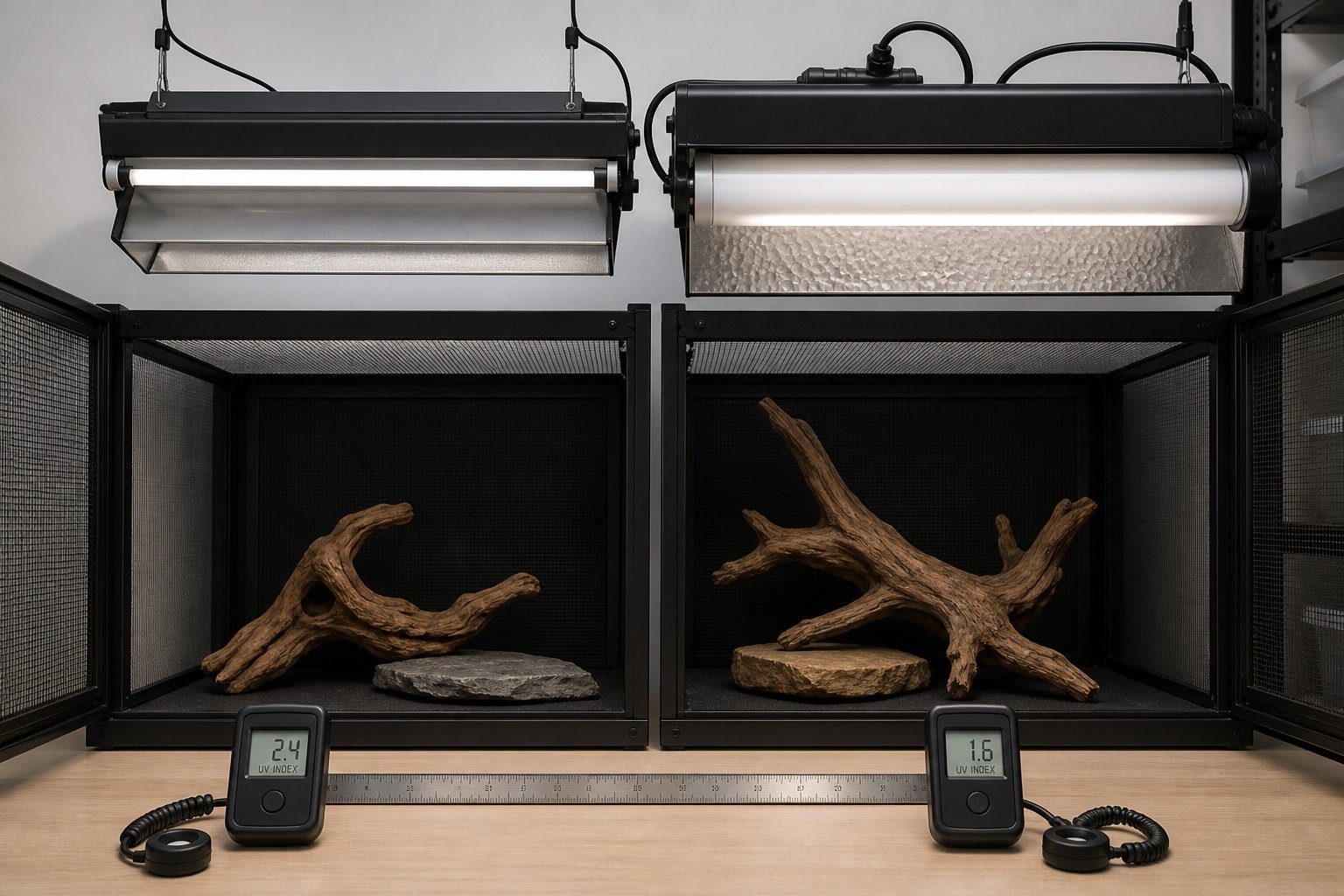
Quick verdict: T5 HO is the practical default for most modern reptile enclosures because it provides wider coverage and more distance headroom. T8 remains useful in shallow, unobstructed habitats where a gentler lamp can sit close to the basking area.
Tube diameter is only part of the comparison. Ballast, reflector, lamp chemistry and mounting distance decide what reaches the animal. Treat T5 and T8 as two systems, not interchangeable tubes.
| Setup or factor | Published or practical value | Use |
|---|---|---|
| Output | Generally higher | Generally lower |
| Useful distance | More headroom | Best at shorter distance |
| Tube diameter | 16 mm | 26 mm |
| Common use | Medium and tall enclosures | Shallow legacy or low-output setups |
Why T5 gained ground
A T5 HO fixture can create a broad zone without being mounted immediately above the animal. That helps when there is a guard, mesh lid or deep enclosure. The smaller tube also works with efficient shaped reflectors.
Where T8 still makes sense
A T8 can be easier to control in a shallow wooden vivarium with internal mounting and no mesh. It may also be the least disruptive replacement when a proven setup already hits the required UVI.
Do not mix parts
A T5 tube does not belong in a T8 fixture. Length, pins, electrical requirements and ballast are different. Replace the fixture and tube as a matched system.
Compare measured zones
Use the method in our UVB buying guide: set the fixture, map UVI at the basking surface, confirm a shaded route, then record the baseline.
Cost over time
T5 fixtures often cost more initially. The useful comparison includes replacement tubes, availability, electricity and whether the old fixture can reach the target without unsafe proximity.
A commissioning routine that catches mistakes
Assemble and run the system before the animal depends on it. Photograph the final positions, label cables, and compare the working zone with an independent instrument. Test one normal day, one night transition and a short power interruption. The goal is not a perfectly flat chart. It is a stable, understandable gradient with safe recovery.
Recheck after cleaning because fixtures, probes and branches rarely return to the exact same position by accident. A two-minute baseline check is cheaper than troubleshooting weeks of unexplained behavior.
Common mistakes
- Calling every T5 lamp high output
- Assuming tube length guarantees wider usable coverage
- Putting a new T5 at the old T8 distance without testing
- Reusing an incompatible ballast
- Ignoring mesh transmission
How to verify the result in a real enclosure
Lighting work becomes much easier when the enclosure is treated as a map rather than a box with one reading. Mark the basking center, both edges of the perch, the warm hide entrance and the darkest retreat. Take measurements at the height of the animal’s back. This reveals whether the reptile can make small choices instead of moving between two extremes.
Visible light, UVB and heat overlap during the day, but each should be evaluated separately. A bright enclosure can still have weak UVB, and a strong UVB fixture does not create the correct basking surface temperature. Keep the lighting schedule consistent, control heat with suitable hardware, and change only one part before repeating the map.
A practical seven-day check
- Day one: photograph positions, record room conditions and capture baseline readings.
- Day two: review the full day-night transition and check that schedules occurred at the intended local time.
- Day three: inspect mounts, probe restraints, plugs, tubing and any area exposed to moisture.
- Day four: compare the main reading with an independent instrument placed beside it long enough to stabilize.
- Day five: review animal access and behavior. Confirm that equipment does not block hides, climbing routes or the cool zone.
- Day six: simulate one safe failure, such as a short internet loss or power interruption, then check recovery.
- Day seven: save the final settings and observations in the enclosure record.
Repeat the short version of this audit after major cleaning, seasonal room changes or equipment replacement. The point is not constant tinkering. It is catching the few changes that can quietly alter a previously stable habitat.
Related Reptile Tech Lab guides
- best reptile UVB light guide
- Arcadia ProT5 review
- UVB through mesh guide
- Solarmeter 6.5R review
- reptile light timer guide
Frequently asked questions
Is T5 hotter than T8?
Fixture and ballast temperatures vary. Neither should be used as the primary controlled heat source.
Can T8 pass through mesh?
Some output passes, but a low-output system has less margin. Measure below the actual screen.
Should I upgrade a working T8?
Not automatically. Keep it if measured coverage and UVI remain suitable.
Which T5 fixture is a useful benchmark?
Our Arcadia ProT5 review includes published distance data and mounting checks.