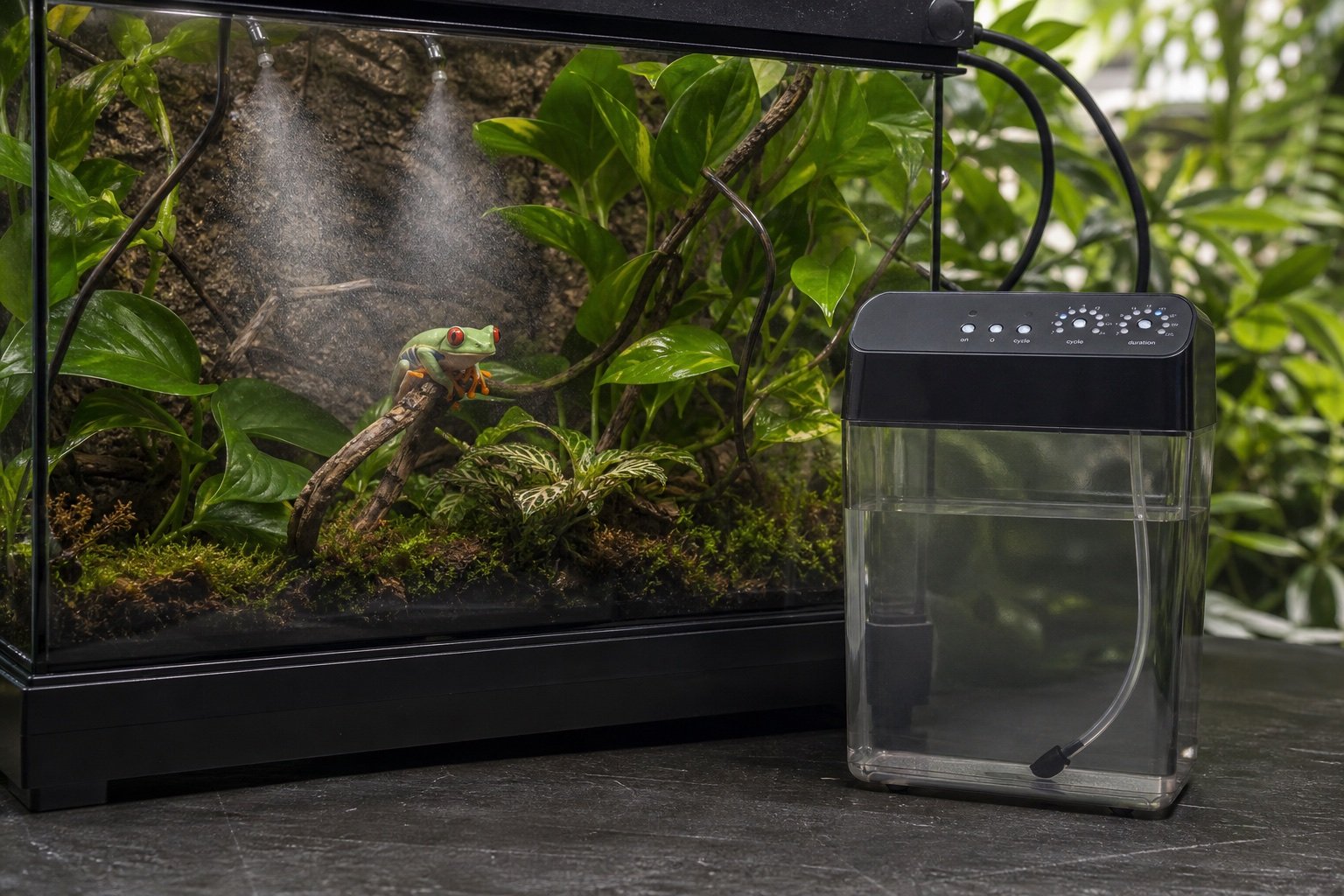
Quick verdict: The Monsoon Multi II is a tidy all-in-one option for one enclosure or a small group. Its 8 L reservoir, two included nozzles and expansion to six make setup approachable. Large racks and long lines expose the limits of an integrated consumer system.
Exo Terra Monsoon Multi II review: pressure, programming and maintenance is a narrow buying and setup question, so this guide stays focused on that job. It does not repeat our broader category pages. The aim is to help you choose, install and verify the equipment without turning one convenient device into a single point of failure.
What matters in this comparison
| Factor | Option or result | Why it matters |
|---|---|---|
| Pressure | 4.5 bar, 65.25 PSI | Adequate for included fine nozzles |
| Reservoir | 8 L | Convenient integrated tank |
| Included nozzles | Two | Enough for a basic start |
| Expansion | Up to six nozzles | Plan equal line lengths |
Specifications are useful for screening products, but enclosure performance depends on placement. Room temperature, ventilation, mesh, substrate moisture and animal access can move the result far from a brochure figure. Work from a measured baseline and change one variable at a time.
How to set it up
1. Rinse the reservoir
Remove manufacturing dust. Test the result under normal enclosure conditions and write down what you observed. A setting that works on an empty bench can behave differently after decor, ventilation and daily room changes are added.
2. Cut tubing square
Poor cuts cause connector leaks. Test the result under normal enclosure conditions and write down what you observed. A setting that works on an empty bench can behave differently after decor, ventilation and daily room changes are added.
3. Route a drip loop
Keep water below electrical connections. Test the result under normal enclosure conditions and write down what you observed. A setting that works on an empty bench can behave differently after decor, ventilation and daily room changes are added.
4. Prime with no animals inside
Catch leaks before substrate is soaked. Test the result under normal enclosure conditions and write down what you observed. A setting that works on an empty bench can behave differently after decor, ventilation and daily room changes are added.
5. Add drainage first
Use our drainage guide. Test the result under normal enclosure conditions and write down what you observed. A setting that works on an empty bench can behave differently after decor, ventilation and daily room changes are added.
What ownership looks like after the first week
The first week should be treated as commissioning, not proof that the system will remain stable. Check the morning minimum, daytime peak and the transition between them. Look for loose probes, wet connectors, drifting clocks, blocked vents and any behavior that suggests the animal cannot use the intended zone.
After the setup settles, use a short written routine. A glance at the device is not enough. Compare it with an independent instrument, inspect cables and mounts, and review stored history when available. Replace consumable parts based on condition and verified performance rather than memory.
Common mistakes
- Running the reservoir dry
- Using mineral-heavy tap water
- Pointing nozzles at electronics or sensors
- Adding six nozzles without checking spray balance
- Letting stagnant water sit between cleanings
Who this approach suits
This approach suits keepers who want a system that another person can understand during a holiday or emergency. It also scales better across several enclosures because labels, baseline readings and failure tests remove guesswork. If a device requires constant manual correction, the installation needs work even when its feature list looks impressive.
How to verify the result in a real enclosure
Water automation must be checked as a complete loop: clean reservoir, pump, tubing, nozzle, enclosure surfaces and drainage. Time one cycle into a measuring jug before installation. Multiply that volume by daily cycles and nozzle count, then compare it with drainage capacity. This simple calculation exposes undersized catch containers before they overflow.
Observe how fast leaves and walls dry after spraying. The useful wet period depends on species and ventilation, but standing water that never clears is a maintenance warning. Adjust nozzle direction and cycle length before increasing frequency. Shorter cycles are not automatically safer if they occur so often that the habitat never dries.
A practical seven-day check
- Day one: photograph positions, record room conditions and capture baseline readings.
- Day two: review the full day-night transition and check that schedules occurred at the intended local time.
- Day three: inspect mounts, probe restraints, plugs, tubing and any area exposed to moisture.
- Day four: compare the main reading with an independent instrument placed beside it long enough to stabilize.
- Day five: review animal access and behavior. Confirm that equipment does not block hides, climbing routes or the cool zone.
- Day six: simulate one safe failure, such as a short internet loss or power interruption, then check recovery.
- Day seven: save the final settings and observations in the enclosure record.
Repeat the short version of this audit after major cleaning, seasonal room changes or equipment replacement. The point is not constant tinkering. It is catching the few changes that can quietly alter a previously stable habitat.
Related Reptile Tech Lab guides
- best reptile misting systems
- MistKing Starter review
- misting drainage guide
- fogger vs mister comparison
Frequently asked questions
Should I rely on the built-in display?
No. Use a separate thermometer, hygrometer, light meter or logger appropriate to the job. Independent verification catches probe movement and controller errors.
How long should I test before animals or eggs depend on it?
At least one complete day-night cycle, and longer for equipment affected by room weather or water use. Incubation and emergency systems deserve several days plus a power-loss test.
Can an app replace local control?
An app is useful for history and alerts. Critical regulation should continue safely when the phone, router or cloud service is unavailable.
What should I record?
Record device model, installation date, set points, probe location, baseline readings and the result of outage or disconnection tests. Those notes make later troubleshooting much faster.