Editorial note: specifications below come from current manufacturer documentation. Consumer sensors can drift, especially in persistent high humidity, so compare them with a known reference before trusting alarms.
Verdict: The best reptile thermometers and hygrometers depend on enclosure conditions. SwitchBot Meter Plus is the strongest value for a readable display, long local history and CSV export. SensorPush HT.w is the better fit for splash-prone tropical setups. Govee H5075 is an inexpensive Bluetooth logger for drier enclosures, while a simple probe display remains useful as a permanent local check. Use at least two measurement points and keep temperature control on a separate thermostat.
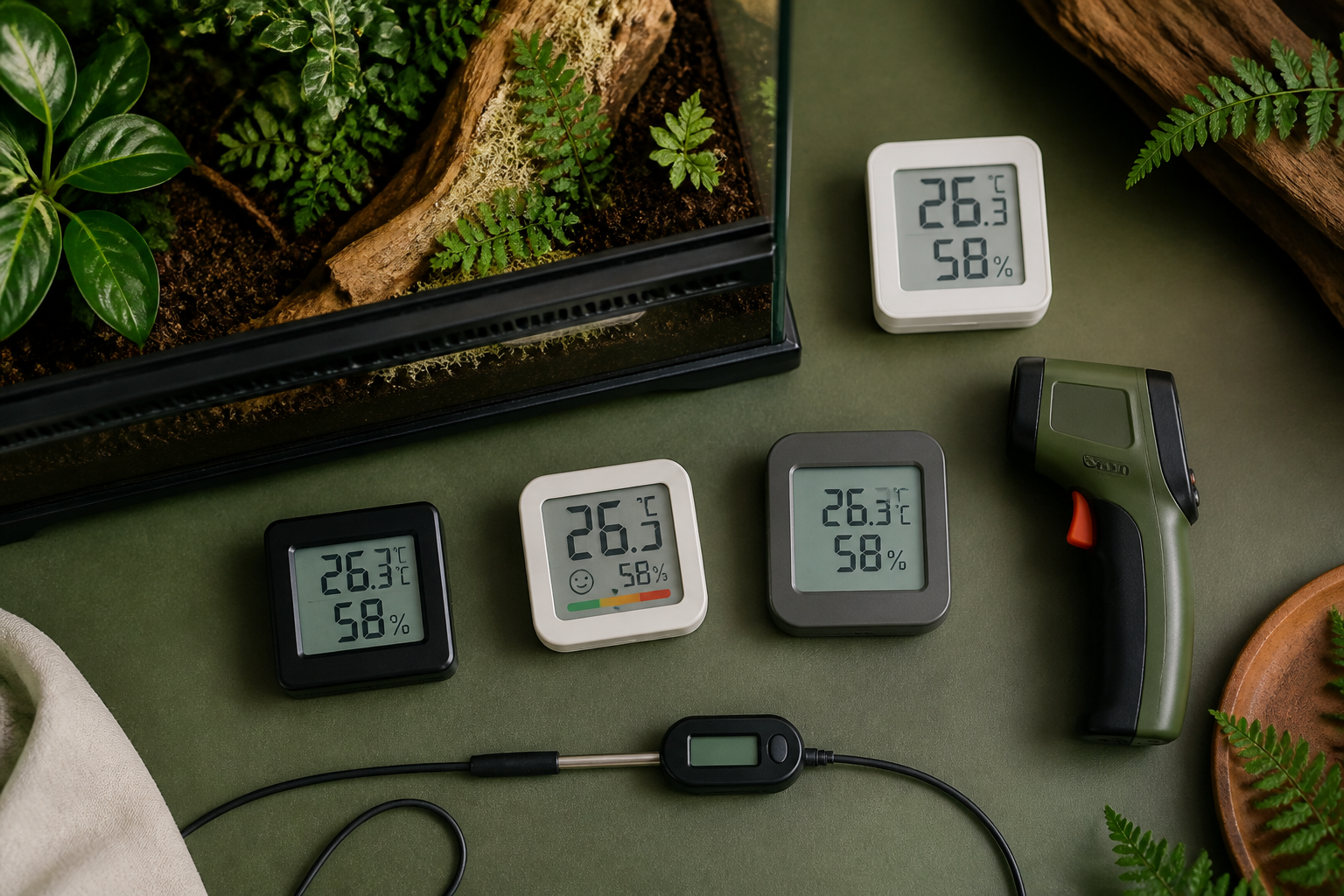
Our shortlist
| Device type | Best use | Main limitation |
|---|---|---|
| SwitchBot Meter Plus | Large display, app history, CSV and optional remote alerts | Remote alerts require a hub; body is not designed for direct spray |
| SensorPush HT.w | Compact logging in humid or splash-prone setups | No built-in display; remote access requires a gateway |
| Govee H5075 | Low-cost Bluetooth history and CSV in ordinary indoor humidity | No native Wi-Fi; high humidity and enclosure walls deserve testing |
| Wired digital probe display | Permanent warm-side or cool-side glance | Often no history, alarm or published accuracy detail |
| Infrared thermometer | Basking surface spot checks | Does not measure ambient air or continuous trends |
Measure a gradient, not a single number
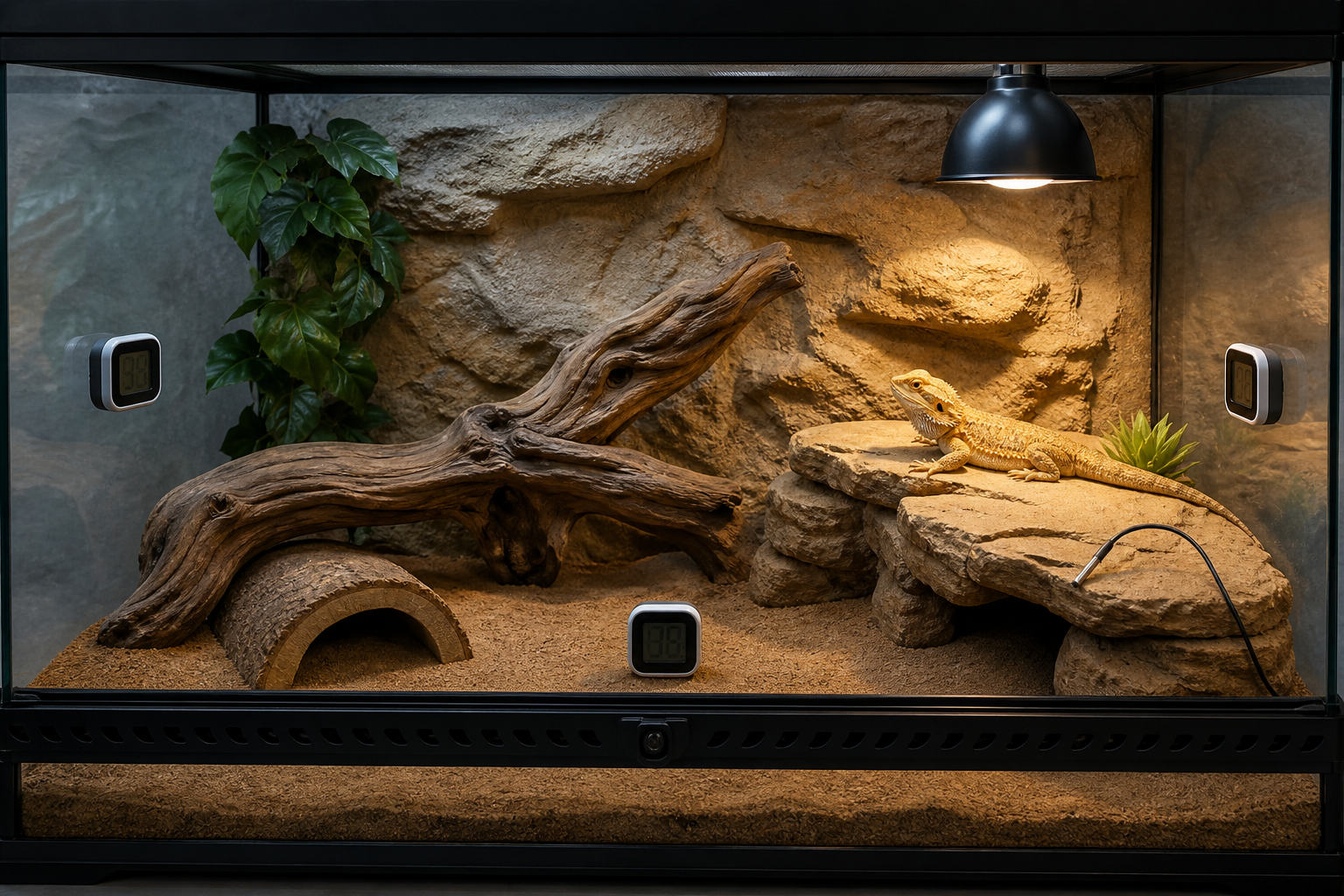
A reptile enclosure should let the animal move between conditions. One sensor in the center hides the warmest accessible surface and the coolest retreat. Place one air sensor on the warm side at animal height and another at the cool side. Add a surface method for the basking point.
Do not place the sensor directly on glass, against a heater or in the mist stream unless that is the specific condition being tested. A display mounted outside with a probe inside can be easier to read and keeps batteries away from the animal.
The existing guide to reptile temperature monitoring tools explains the roles of thermostat probes, air sensors, infrared thermometers and loggers.
SwitchBot Meter Plus
SwitchBot publishes typical accuracy of ±0.2°C between 0 and 65°C and ±2% RH between 10 and 90% RH at 25°C. The Meter Plus has a three-inch display, Bluetooth range quoted up to 120 meters in open conditions, about 68 days of onboard history and CSV export. A SwitchBot hub adds remote notifications and cloud history.
The large screen is genuinely useful in a reptile room. You can spot a problem without opening an app. Local storage also means a phone can reconnect later and collect missed readings. Test sync time before leaving the sensor unattended for weeks.
Published open-air range will not survive walls, rack material and water unchanged. Put the sensor in the final enclosure, close every door and test from the place where the phone or hub will normally sit.
SensorPush HT1 and HT.w
SensorPush stores readings on the sensor and transfers them by Bluetooth. The HT1 records at one-minute intervals and holds more than two weeks of data. The company lists typical accuracy of ±0.3°C and ±3% RH in the central humidity range. It also warns that prolonged exposure above 80% RH may create a temporary positive humidity offset.
For tropical enclosures, the water-resistant HT.w is the more sensible starting point. Its seals and protective membrane are designed for splashes, though water-resistant does not mean the sensor should sit under a nozzle. The optional G1 gateway provides remote access for multiple sensors.
SensorPush has no built-in display, so pair it with a visible local gauge or accept that every check happens in the app. Its compact body makes placement easier, but protect it from chewing, crushing and direct contact with the animal.
Govee H5075
Govee H5075 combines a local LCD, Bluetooth app history, alert thresholds and CSV export. The current product page says it uses two AAA batteries, lasts about six months and connects up to 50 meters in open conditions. It does not have native Wi-Fi.
That makes it a good budget logger for a snake room or drier display enclosure. It is less convincing when the sensor will remain near saturation or receive spray. The detailed Govee H5075 reptile review covers placement, Bluetooth behavior and export checks.
Why cheap analog dials are hard to trust
Small stick-on analog gauges often have no useful accuracy specification and respond slowly. Adhesive can also fail in heat and humidity. If one is already installed, compare it at several stable conditions rather than assuming the pointer is correct.
A digital number can be wrong too. The advantage is easier comparison and, on logging models, a visible trend. Buy published accuracy, calibration support and replaceable batteries before decorative packaging.
Humidity is the harder measurement
Relative humidity changes when temperature changes, even if the amount of water vapor stays similar. A sensor close to a warm lamp can show a lower RH than one in a cooler hide. That does not automatically mean either device is faulty.
Misting creates a sharp local spike, followed by drying. A sensor in the spray cone reports droplets more than enclosure climate and may become saturated. Place it where the animal spends time, shield it from direct mist and study the recovery curve.
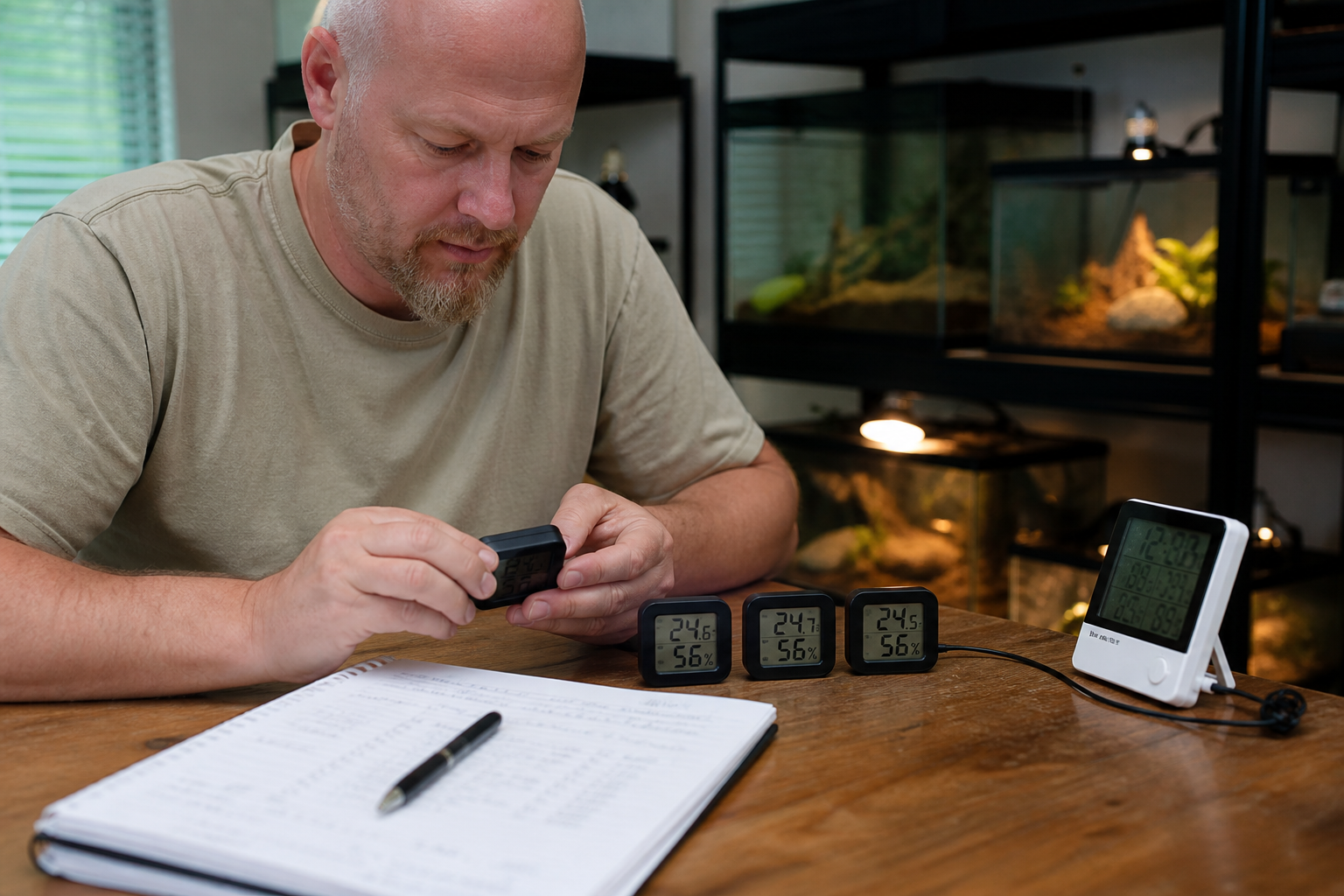
Persistent high humidity can shift consumer sensors. Compare two devices periodically and investigate widening disagreement. Do not use one unverified number to diagnose respiratory or shedding problems; record conditions and consult a qualified reptile veterinarian when health is involved.
How to compare accuracy at home
- Place all sensors together in a stable room away from sunlight, vents and heaters.
- Wait several hours, not several minutes.
- Record temperature and humidity from every device.
- Repeat at a second condition that still falls inside the published range.
- Use calibration offsets only after the difference is repeatable.
- Label each device with the date and offset.
A salt test can create a reference humidity point, but contamination, temperature instability and poor sealing easily spoil the result. Follow a reliable procedure and do not treat a kitchen experiment as laboratory certification.
Logging and alerts
History should answer three questions: how high, how low and for how long. A daily minimum and maximum can hide a ten-minute overheat. Inspect the actual curve and learn the sensor’s sampling interval.
Set alerts wide enough to avoid constant nuisance notifications but narrow enough to catch a real equipment failure. Test them. Put the phone in Do Not Disturb, disconnect Bluetooth and turn off the hub to learn which alerts still arrive.
Export a CSV before relying on years of app history. Confirm timestamps, units and sensor names. The data export and privacy checklist applies to sensor apps as much as husbandry trackers.
Placement by enclosure type
Glass display enclosure
Keep the display where it can be read without opening doors. Place sensors away from cold exterior glass and direct lamp radiation. Check night-time cooling near the lower vents.
PVC enclosure
Wireless signals may behave better than through a metal rack, but foil insulation and dense shelving can still reduce range. Secure sensors so a strong snake cannot push them into the water bowl.
Rack system
Do not assume one room sensor represents every tub. Measure representative upper, middle and lower positions, then move a logger periodically to audit variation.
Tropical vivarium
Choose a splash-resistant body, keep it outside the nozzle cone and watch recovery after misting. The misting system guide covers nozzle placement and drying cycles.
A practical monitoring kit
For one enclosure, use a reliable thermostat, two air temperature sensors, one humidity sensor where relevant and an infrared thermometer for surfaces. A combined thermo-hygrometer can cover one air point, but it does not remove the need to check the cool end.
For a room, add a logger outside the enclosures. Room temperature explains changes seen across several habitats and can warn when HVAC failure is driving every controller harder.
Frequently asked questions
Can a hygrometer control a mister?
A monitor only reports conditions. Automatic control needs a compatible hygrostat or controller, and timer-based misting is often easier to reason about than chasing a single RH setpoint.
Is Bluetooth enough for alerts?
Only while the phone or gateway remains in range and the app is allowed to run. Test the final placement and notification settings.
How often should sensors be checked?
Compare them when new, after battery changes, after prolonged high humidity and whenever two devices begin to disagree.
Can I put a sensor inside a snake enclosure?
Yes if it is securely mounted, has no exposed adhesive or loose cable, cannot be swallowed or crushed, and stays within the manufacturer’s environmental limits.